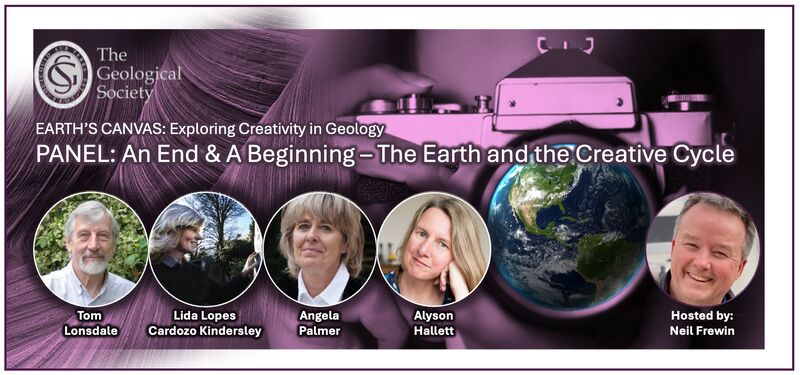
How do artists bring together science, partnerships and materials for major projects? This was explored during a panel dialogue on 18 September 2024 as part of Earth’s Canvas. Facilitator Neil Frewin asked key questions of panelists Angela Palmer, Tom Lonsdale, Lida Lopes Cardozo Kindersley and Alyson Hallett.
How are logistics managed to deliver big projects? Angela described challenges such as dealing with power lines in Africa or Christmas lights in Trafalgar Square.
How can one choose a sense of place? Tom said that you either feel the sense - or you don’t. You might have evidence of its history from physical clues, anecdotes or myth.
In art and creativity are you used to dealing with deadlines? Audience laughter met an assertion that artistic projects were not driven by deadlines. Nevertheless, Lida said that deadliness are not usually as pressing for headstones and memorials.
How scientists and artists build partnerships? Alyson views rocks as part of the team to be met, held, smelt, drawn and introduced. Tom encouraged building skills of navigation, although partner organisation staff can rotate so relationships collapse. Lida starts with openness to possibilities - it’s not just ‘you telling me and me telling you’. Angela can’t do any work without partnerships and finds scientists can be incredibly generous. Attendee Ruth Siddall noted that science councils do not value artistic collaboration given how science is assessed, but that arts and humanities organisations have proven much more receptive to funding cross-disciplinary work.
How can we measure the ‘impact’ of creative work when applying to funding bodies? Tom shared that conservation planning has useful words - harm and benefit - where the benefit should outweigh any harm. Alyson in an early project calculated the number of raindrops, leaves, cows interacting with a migrating stone - a playful approach that was funded. Angela sees outreach as an important measure such as with education departments in museums engaging children. Lida had not heard the term ‘impact’ before today in the context of funding; she believes creativity is not about impact - we just want to make the world a bit better. These comments prompted contributions from a broader range of attendees. Olivia Rafferty saw the impact on development of the artist to enable them to go further down their road, create new work and reach out more. John Bolland reflected that impact can be greatest when the uncertainty on answering the question is greater. It can sometimes be enough to change just one person’s life. But if one can’t measure impact, what alternative method is there to assess a funding proposal? Measurement of ‘impact’ of a creative project for funding bodies was clearly the most contentious topic of the conference.
How can you sum up the experience of the last couple of days at Earth’s Canvas? Alyson thanked the generosity of the Geological Society and appreciated an amazing atmosphere of enquiry and sharing with ‘delicious’ conversation. Tom was at a school that allowed the mixing of arts and sciences, and the conference was a glorious reassurance that these worlds are enmeshed. Lida said that we are all diggers, trying to do the hard work to get to some level of knowledge, meeting other diggers on the way. Angela encouraged us to never stop being curious - highlighting the ‘impact’ of curiosity.
Earth's Canvas
https://geoscientist.online/sections/unearthed/earths-canvas-2/
Tom Lonsdale
http://www.placecraft.co.uk
Lida Lopes Cardozo Kindersley
https://en.wikipedia.org/wiki/Lida_Lopes_Cardozo_Kindersley
Angela Palmer
https://www.angelaspalmer.com
Alyson Hallett
https://alysonhallett.com
Neil Frewin
https://www.linkedin.com/in/neilfrewin
Ruth Siddall
https://ruthsiddall.co.uk/Home.html
John Bolland
https://aviewfromthelonggrass.com
Olivia Rafferty
http://www.oliviarafferty.com