EXPLORING GEOLOGY IN CREATIVITY

Hutton tercentenary and creative arts (2026) 

The Hutton tercentenary celebrations and events are underway in Edinburgh. This is appropriate for a city with exciting geology,  a vibrant cultural life and strong links to key figures of the Scottish enlightenment - of which Hutton is one.

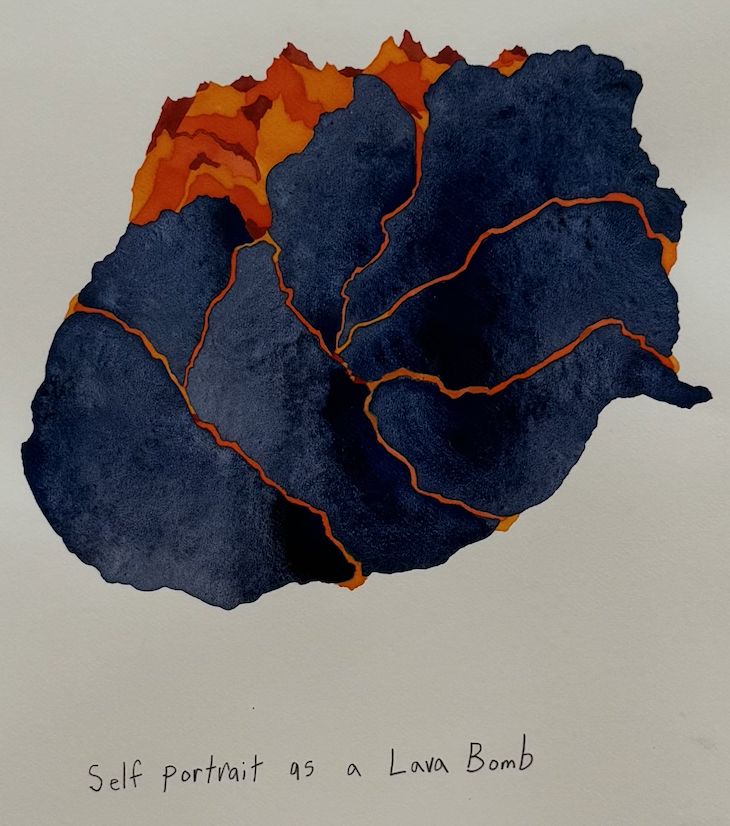
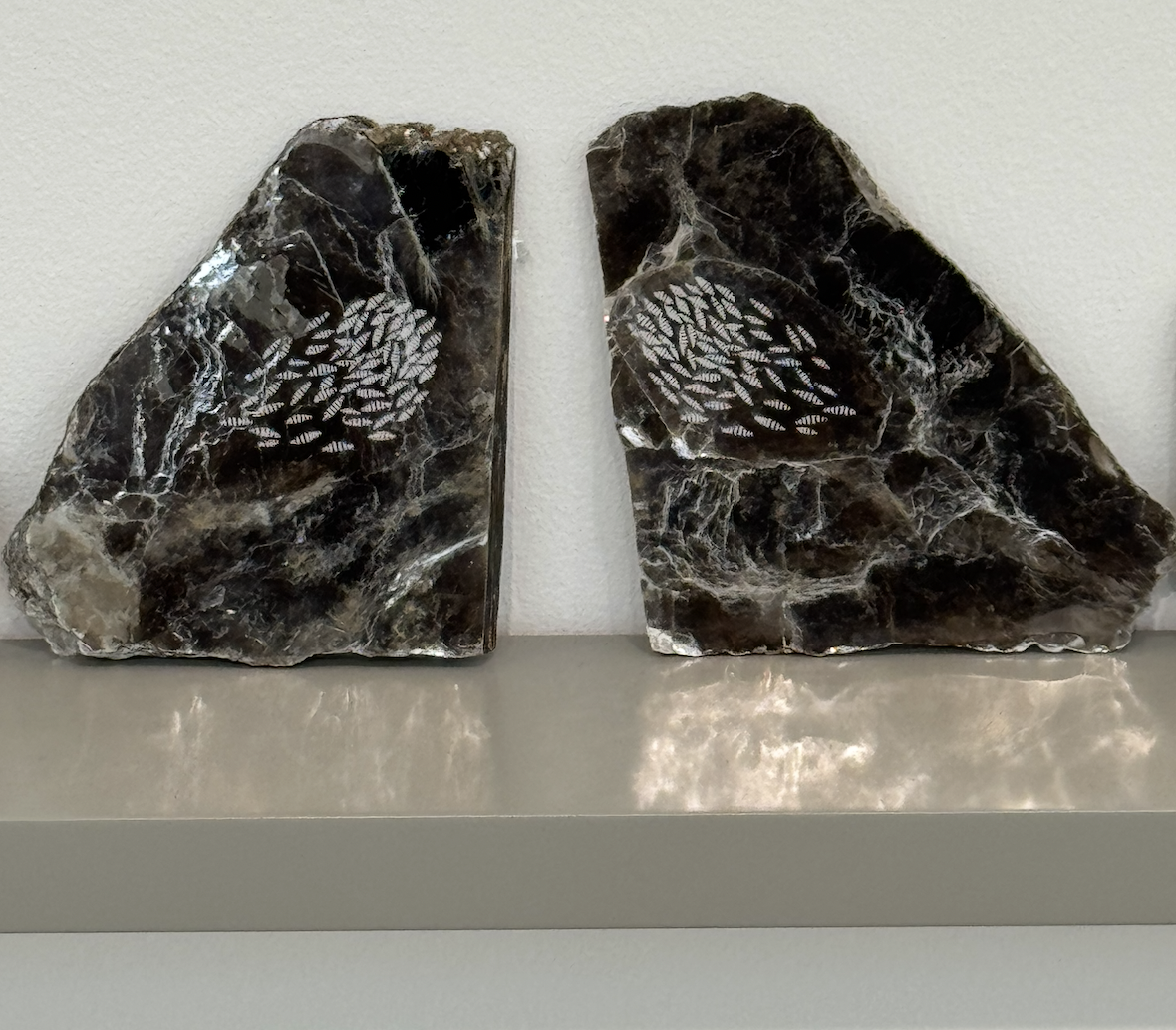
The first offering is at Fruitmarket Gallery, in the centre of town by Waverley railway station, which hosts  an exhibition by Ilana Halperin, who reflects that ‘James Hutton’s radical geological act is just as relevant today as it was 300 years ago’. The showing begins with a collection of analogue images from around the world from fieldwork, a common thread between geologists and artists. A central theme of the artwork is comparing volcanic life and human life.  She reveals ‘ the strongest affinity with Eldfell as we were both born in 1973’, taken to a deeper level in paintings such as Self portrait as a Lava Bomb. The Library mica books (commissioned for a project in Bute) draw parallels between the stories told by humans and by the evolution of the rocks.  She reflects on the origin of elements such as iron which colours Mars and our blood, used as the basis of dramatic colour swathes covering the gallery wall, concluding ‘how can we make a distinction between what is us and what is Earth.’ This body of work represents a powerful individual response to geology.

A diverse exhibition is at Inverleith House, in the centre of the Royal Botanic Garden, called Earth Matters and curated by Susanna Beaumont. Paint colours on various walls reflect the hues of soil samples from around Scotland found in the collection of the James Hutton Institute, a key partner in the exhibition. Upon entry to the gallery spaces there is a big impact from The Unconformities by Louise Bennetts, suspended textiles with a transparency recalling folio pages and layers of geology and time. Pieces with direct Hutton inspiration include those from Graham Todd, George Perry and Ilana Halperin. There is a  direct connection to Hutton not only through John Kay’s 1787 caricature of Hutton with rock hammer in hand chipping away at the profiles of the old guard, but also through a first edition of Theory of the Earth. Perhaps the centre piece is River of Earth by Becky Little and Tom Morton which reflects endless cycles shaped by weather and water, with a decreasing grain size downstream that will resonate with sedimentologists and other geologists. This collection clearly links  Hutton’s historical insights to modern creativity.

These two exhibitions and key protagonists will be connected through a Panel discussion: glancing backwards into a time that far predates us  on Earth Day (22nd April). This conversation will also include Karine Polwart, who with Dave Milligan will be headlining Hutton 300: the concert (27th June), which I have the honour of producing for  the Edinburgh Geological Society at Greyfriars Kirk. There is yet more to come as part of the Royal Scottish Academy exhibition,  and inclusion of music and poetry as part of the  Deep Time Trail leading to Siccar Point. It is heartening to see such a wide and broadening array of creativity inspired by geology in this landmark year.

James Hutton Tercentenary: Calendar of events
https://james-hutton.org/events/

Ilana Halperin: What is Us and What is Earth
https://www.fruitmarket.co.uk/event/ilana-halperin/

Earth Matters: seeing soil through art
https://www.rbge.org.uk/whats-on/earth-matters/65719/

Panel discussion: glancing backwards into a time that far predates us 
https://www.fruitmarket.co.uk/event/panel-discussion-glancing-backwards/

Hutton 300: the concert
https://edinburghgeolsoc.org/hutton300/

Deep Time Trail
https://james-hutton.org/deep-time-trail/
 

Ilana Halperin: Self Portrait as a Lava Bomb (2023)
Ilana Halperin: The Library (detail) (2013)
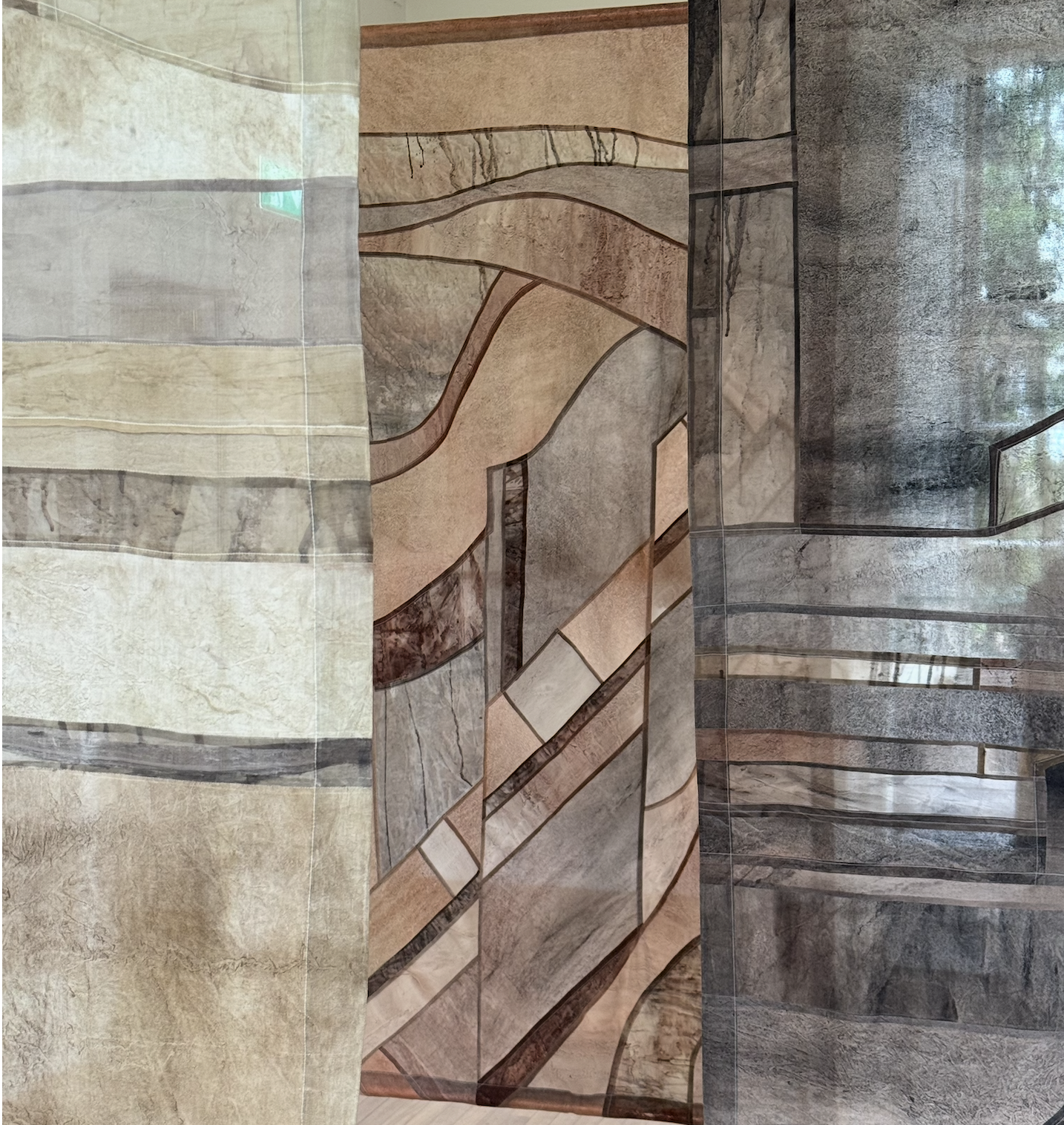
Louise Bennetts: The Unconformities (Jedburgh, Castle St, Salisbury Crags) (2026)
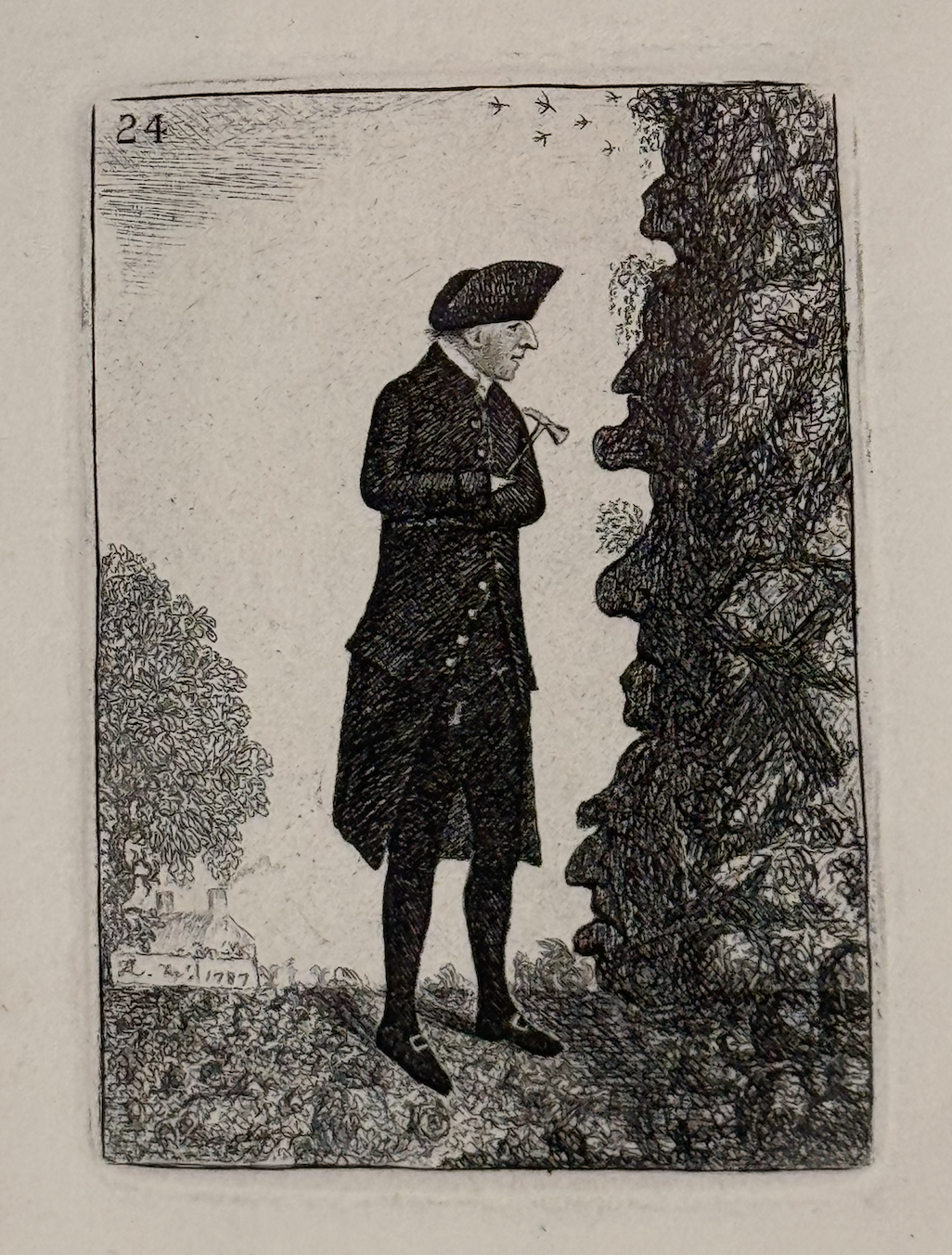
John Kay: Dr James Hutton (1787)
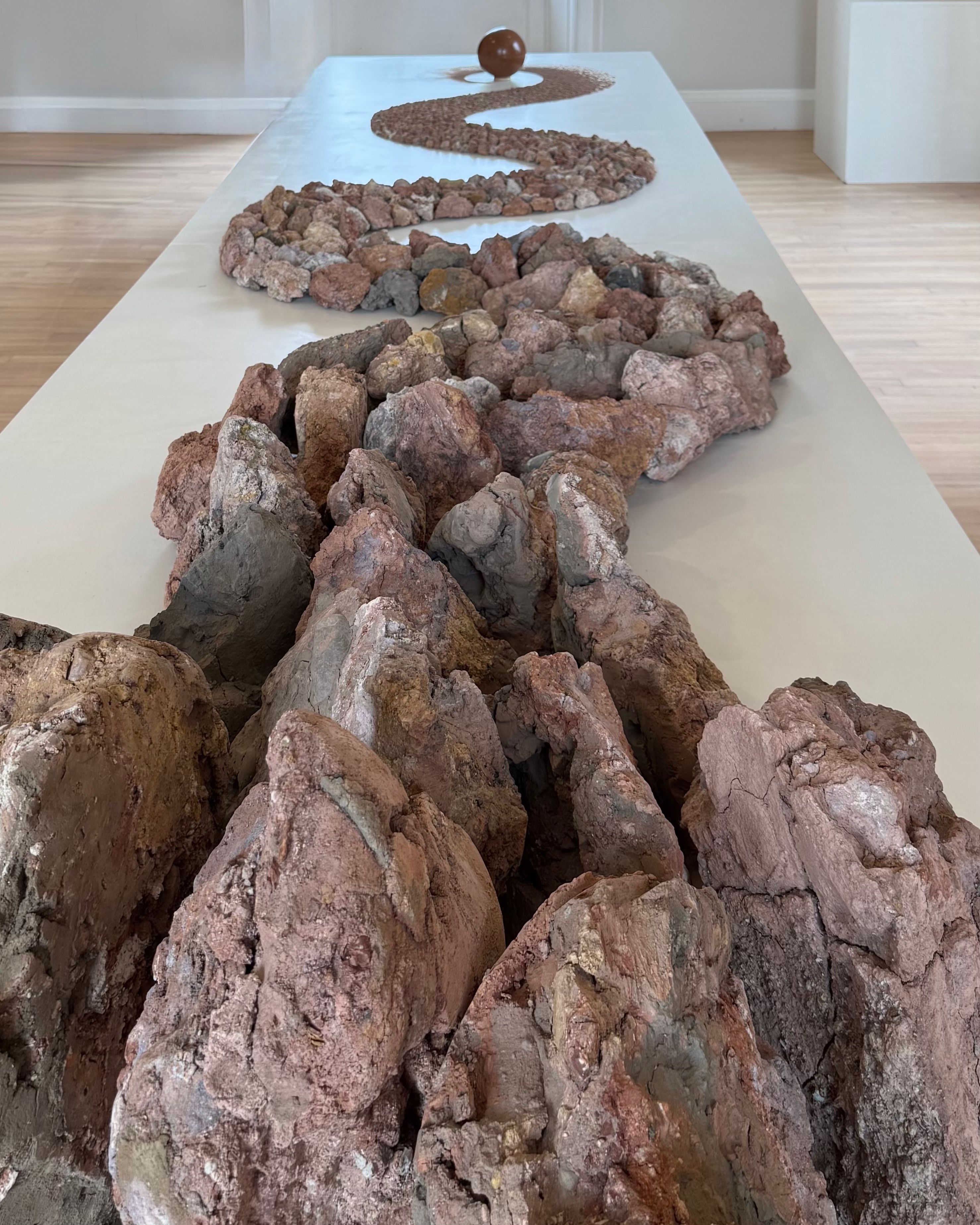
Becky Little and Tom Morton: River of Earth (2026)
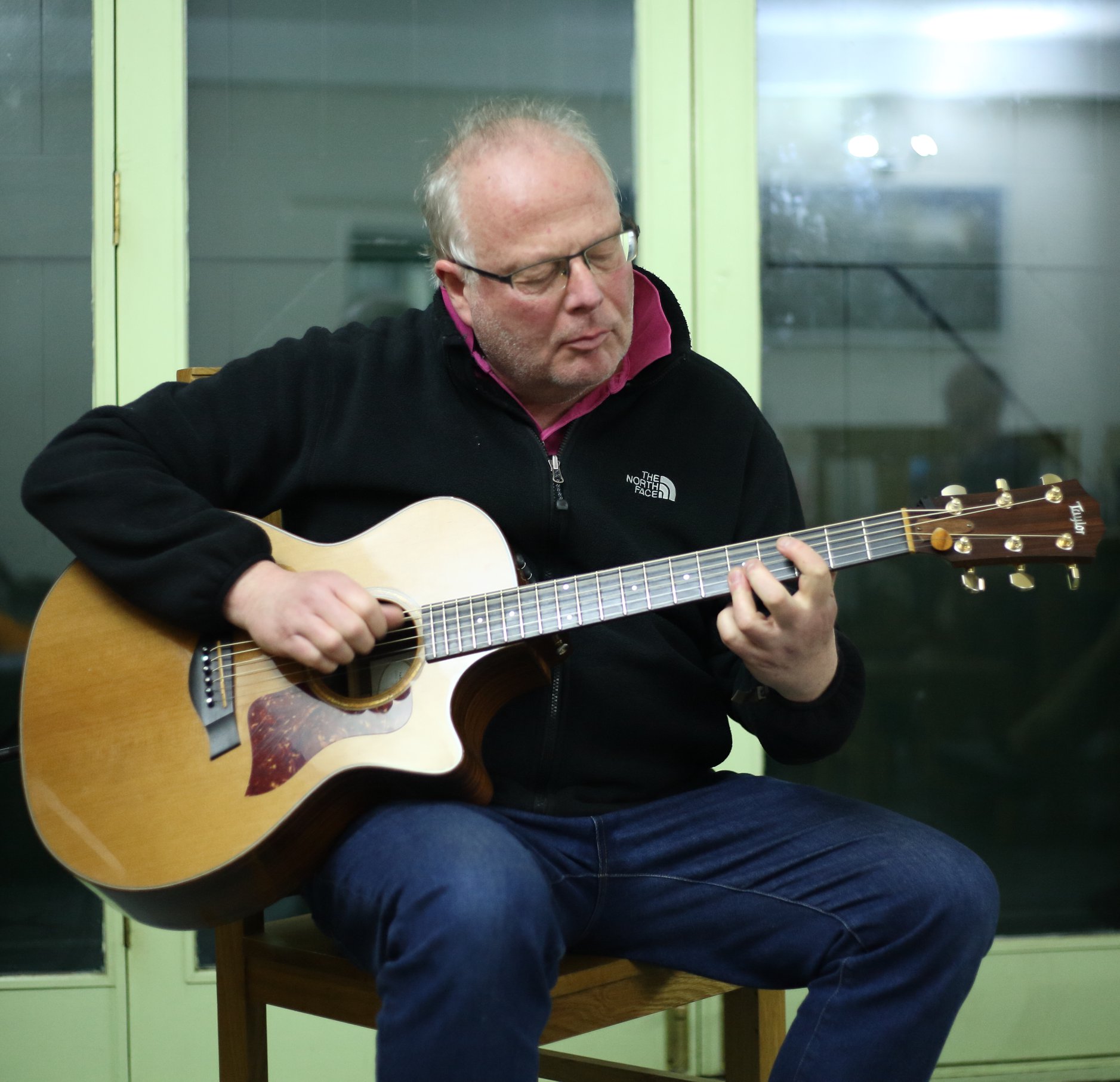
Climate signals, ice quakes and Earth history: ’The Song of the Ice’ 2020-2026 

It has now been more than five years since the launch of ‘The Song of the Ice’, causing me to reflect on its creation and evolution through performance. 

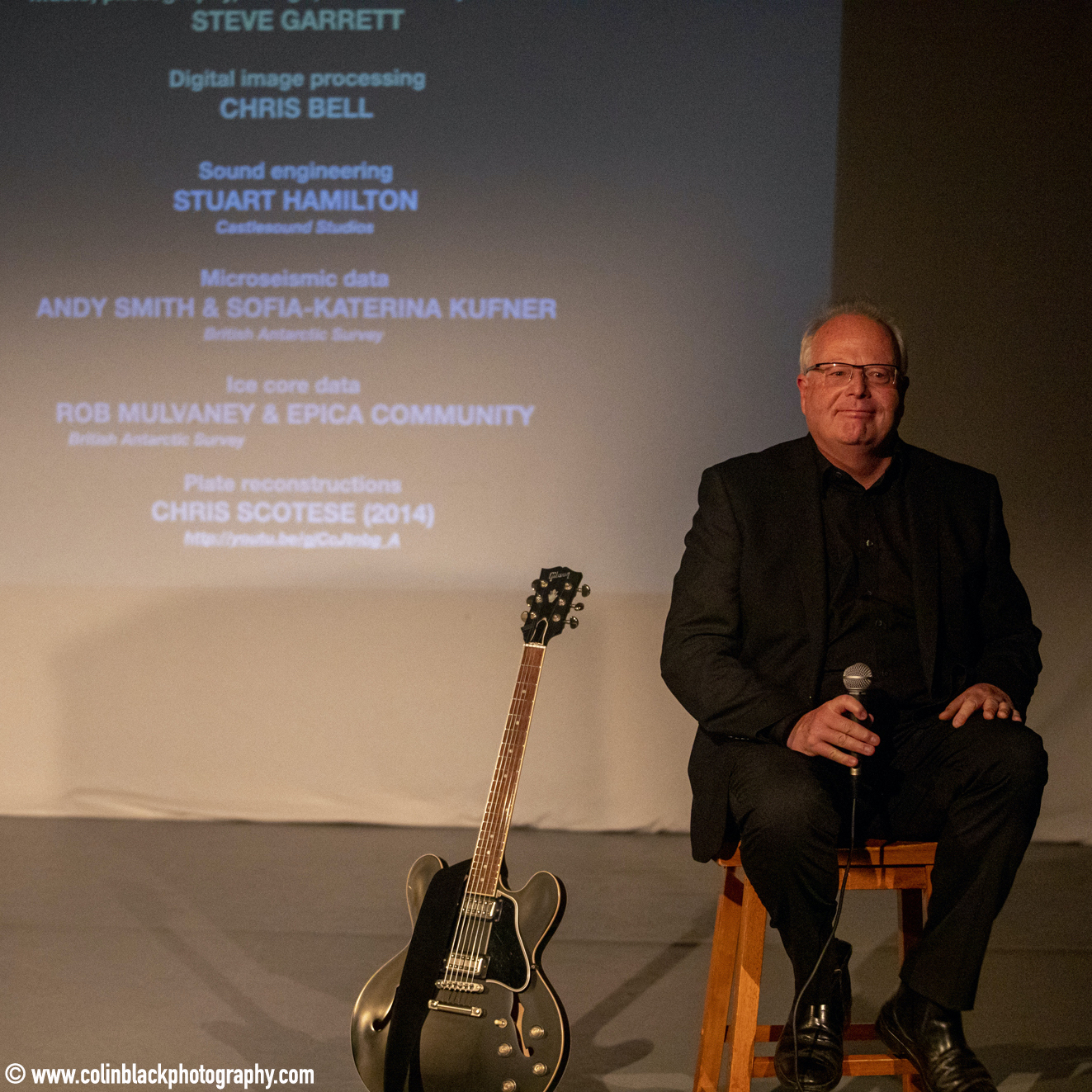
Creation involved a lot of hard work on the computer. For example, Part 1 ‘Isolate  involved digitising and animating continental outlines from videos made by Chris Scotese. I checked these against the latest scientific literature and validated conclusions with Teal Riley at the British Antarctic Survey (BAS). 180 million years was compressed into 5 minutes and the music composition was synchronised to the graphics. This section was perhaps the most difficult to execute - but, sadly, seems to have had less direct impact on non-geologists.

Fun and innovation was a feature of part 2 ‘Grow’. Following an idea from Andy Smith (BAS), geophysical ice quake recordings by Sofia Kufner were taken into the recording studio to turn into sound that humans could relate to, taking our imaginations to a dark place beneath the ice.  Stuart Hamilton at Castlesound and I had a great day doing this - although I recall the look of mild horror on his face when confronted with raw geophysical data at the start of the morning. Beautiful images from my fieldwork were digitised by Chris Bell and set to music that has been described as ‘playful’ reflecting the growth of the ice sheet from infancy to maturity.

Listener emotional reactions have been strongest to part 3 ‘Breathe’. Atmospheric carbon dioxide concentrations  from the past 800,000 years from ice cores, measured in parts per million (ppm), were provided by Rob Mulvaney at BAS. I converted these to a tune with notes whose frequency is measured in cycles per second (Hz).  The music ends on the last, sustained, highest note (Ab) reflecting the abrupt recent rise in concentrations to above 415 ppm. People have responded by calling the music ‘beautiful’, ‘evocative’ and ‘sadly relevant’.
Performance over the past 5 years has evolved to become more of personal response to the continent, rather than just a performance of the music. I now include an introduction to heroes from the heroic days of Antarctic exploration and a comparison of observations during my Antarctic visits in the 1980s and on my return in 2024. This inspired a new part 4 ‘Change’, set to images of increased snowfall on the mountains, absent sea ice, prospering seals and whales, and a noticeable ‘greening’ of islands.

Audience interaction has become an increasingly important part of the performance at festivals and conferences across Britain. A Q&A session has helped develop a deeper understanding, interest and affection for the southernmost continent. There are always surprising questions.  It has been heartening to see a healthy mix in the audience demographics of age, gender, and visible diversity.

After a break in 2025, I look forward to bringing The Song of the Ice back to festivals in 2026, hoping  to add even stronger visuals to increase impact.

2020 - unveililing a ‘first draft’ to Antarctic friends at a remote hostel in the hills
 

2021 - Q&A session after live premier at Sound Festival
 

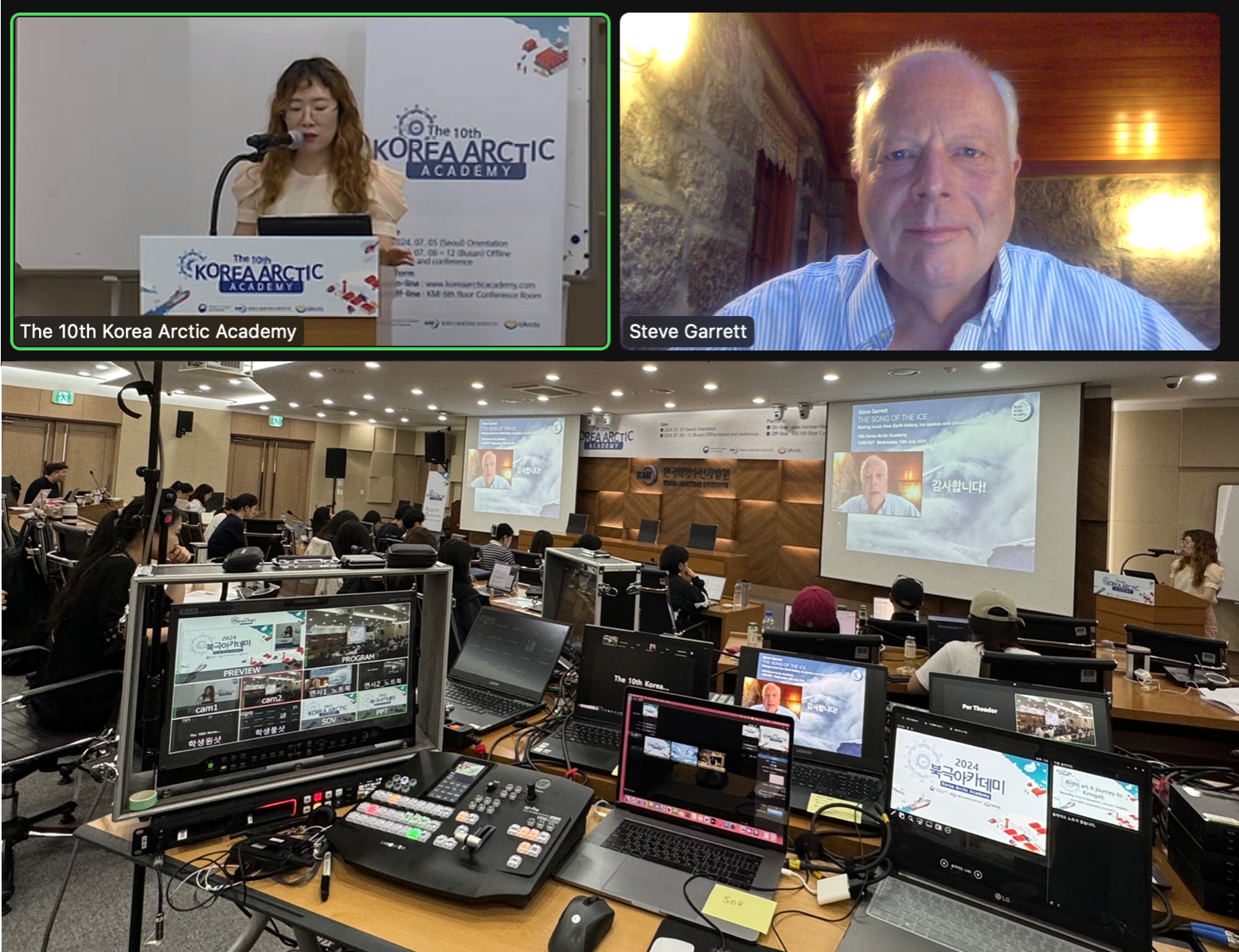
2024 - remote presentation to the Korean Arctic Academy
 

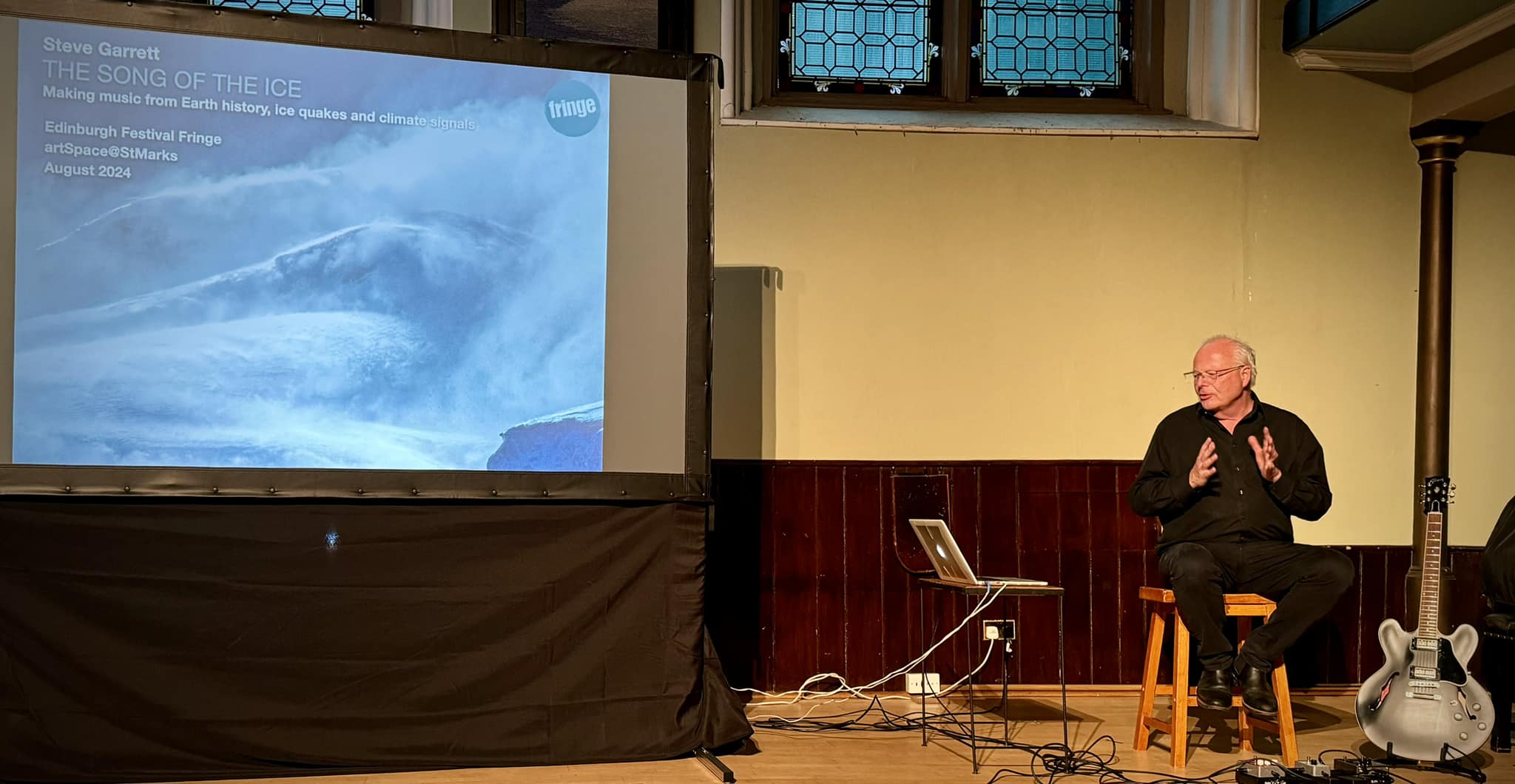
2024 - Edinburgh Festival Fringe

BAS press release for online launch event
https://www.bas.ac.uk/media-post/earth-day-2020-the-song-of-the-ice/
Geoscientist article
https://www.geolsoc.org.uk/~/media/shared/documents/geoscientist/2020/august%202020/Geo_August2020_PN.pdf
The Song of the Ice - live
https://stevegarrettguitar.com/the-song-of-the-ice-live
Steve Garrett guitar events
https://stevegarrettguitar.com/events

The way that we see - Phoebe Sleath (2020-25) 

I was pleased to meet with Phoebe Sleath a week after the successful defence of her doctoral thesis. This gave an opportunity for her to reflect and decompress after the intense work of writing up and preparation for an academic viva.

The  chosen venue was Greyhope Bay centre overlooking the coast, entrance to Aberdeen Harbour and North Sea. Sitting there has the benefits of feeling  in the environment while safely protected behind large glass panels and warmed by a wood burning stove. As we talked we could watch the wind, rain, sun and cloud in an ever-changing array of watercolour skies. The centre sits appropriately on a headland with sedimentary, metamorphic and igneous rocks that illustrate fundamental geological ideas. 

Phoebe brought her field note books, which combine both artistic and scientific observations. She had started sketching and painting ‘en plein air’ as an act of observation during PhD fieldwork in locations such as Tuscany and Pembroke:

“I painted the vibrant viridian sea and the deep cobalt sky, and then I moved to the rocks, thick paint for the Windsor red mudstones and diluted washes for the pale grey sandstones. As I painted the wind blew the clouds away from the sun and the light changed, moving and deepening the shadows. I mixed red and blue for dark purple to bring out the different faults and fractures. I realised that I was looking at the rocks in a different way, that painting was guiding my thoughts, and creating my scientific method. I felt a beautiful clarity and connection, in both looking at the landscape as a whole and the rocks and structure in all their details. I was enjoying being in the scientific process. I started to ask myself questions, had other geologists been here before me? Had they sat in the same spot? Had they seen the outcrop in the same way?”

Sketching and painting the rocks required taking the time to observe the details of the structure of the Earth. This is perhaps more mindful and meditative an approach than measurement or photography alone. During our conversation, Phoebe stressed the process of observation as much as the products of paintings and papers. She articulates this through a film and workshops as part of diverse mountain festivals, or during her work as a climber and Mountain Leader.

So why does this matter? In trying to piece together the complex structure of the earth, geologists  often have to combine sparse data from outcrops while trying to visualise underyling patterns and processes in three dimensions and over geological time - while bearing in mind that   "All models are wrong, but some are useful” (George Box). It is important to keep testing models agains field observations. This in turn relies on how things are seen by the observer.

Reflecting on our dialogue reminded me of the song by Canadian singer songwriter Bruce Cockburn:

Little round planet
In a big universe
Sometimes it looks blessed
Sometimes it looks cursed
Depends on what you look at obviously
But even more it depends on the way that you see.

  Phoebe Sleath’s field notebook

Greyhope Bay Centre.
https://www.greyhopebay.com/

Phoebe Sleath. 2024. Linking Geology and Art in the field - insights from mountains and fold-thrust structures. Sedgewick Club talks, University of Cambridge.
https://talks.cam.ac.uk/talk/index/223648

Phoebe Sleath. 2024. Creativity and geology. European Geophysical Union.
https://blogs.egu.eu/divisions/gd/2024/09/18/creativity-and-geology/

Phoebe Sleath, Clare Bond and Rob Butler. 2024. Ramps first – Interpreting thrust nucleation in multilayers. Journal of Structural Geology, vol. 185,105190
https://www.sciencedirect.com/science/article/pii/S0191814124001421

Bruce Cockburn. 1989. Child of the Wind.
https://cockburnproject.net/songs&music/cotw.html
 

A Braemar Musical Geotrail (2025) - inspiring geology, sounds and music 

As part of 2025 Deeside Nature Festival I led 20 participants on a  guided walk up Creag Chòinnich to experience hundreds of millions of years of Earth history in a few hours - continental collision, mountain building, glaciation, river erosion. The walk was accompanied by sounds and music inspired by rivers, ice and granite from local community projects.

Geology and creative arts are united by observation and response to the natural environment (as has been noted by Rob Mackay).  So we stressed observation of the ground beneath our feet, looking for changes in slope and examining the character of the rocks themselves. We followed a trail blazed by Stuart Archer during the 2024 festival.

The trail began in Braemar town centre where the  Cluny Water dramatically cut through quartzites, the oldest rocks we would see. Going through a gate and uphill into pleasant Scots pine woods, the change of slope reflected a change to younger rocks - although they are thought to still be more than 700 million years old.

A change of bedrock was revealed by a change of slope with steps and rounded exposures of granite. We stopped so I could play a tune and attendees enjoy a Tunnock’s wafer. ‘427 Million Years' by Adam Sutherland was composed as part of a 2019 Braemar music project ‘What a Story This Pair of Boots Could Tell’.  The tune was inspired by the age of the granite which forms the Cairngorms (although some geologists may note that published studies suggest a more precise range of 318-419 million years). The evocative tune seems to convey the slow passage of geological time itself. 

As we progressed up the hill we could see evidence of the intrusive contact between the granite and host rock in several places. Reaching a high point, a broad panorama was revealed of the valley of the River Dee and the granite ridge of the Cairngorms. Playing back the sound of ‘ice quakes’ from Antarctica through a portable speaker helped us to consider the shaping of the land by thick ice during the past 2 million years. The icequakes are from geophysical recordings of movement of thick ice over bedrock in Antarctica and the sound helped us to visualise kilometres of ice overhead.

Over the past 10 thousand years the most recent changes in the landscape have been from the action of water. Today, the source of the River Dee is high up in the Cairngorms where a spring rises from fractures in the granite, inspiring a Hamish Napier tune  The Wells of Dee’. This was composed and recorded as part of a 2021 NE Scotland project ‘Our Living Rivers and Glens’. The project gave people isolated during lockdown the opportunity capture observations from the natural environment, which was posted on a Google Earth map and used as inspiration for new music commissions. 

We then headed back downhill as a rainstorm approached from the west.

Despite the potential risks of bringing walking, science and music together in this way, there was good feedback from participants.  ‘The music was inspiring and I can see why so many musicians take inspiration from the area.  Thank you so much for sharing your passion with us.
 

Geological map of the walk

Sketch cross section of the walk (vertical exaggeration x 3.5)

Briefing as we enter the woods

‘427 Million Years’ - granite and Tunnocks

‘The Wells of Dee’ - near the summit

Deeside Nature Festival
https://wild-discovery.com/deeside-nature-festival
Adam Sutherland
http://www.adamsutherland.co.uk/
What a story this pair of boots could tell
http://www.adamsutherland.co.uk/shop/
427 Million Years
https://youtu.be/Caj-4QLi3Bs?si=7rt3N1sdngUwMmlw&t=98
The Song of the Ice
https://www.youtube.com/watch?v=iAwHB-yjVGY
Icequakes
https://stevegarrettguitar.bandcamp.com/track/the-song-of-the-ice-icequakes-bonus-track
Our Living Rivers and Glens
https://deedonceilidhcollective.com/our-living-rivers-and-glens
Hamish Napier
https://www.hamishnapier.com/
The Wells of Dee
https://deedonceilidhcollective.com/track/2859073/the-wells-of-dee
 

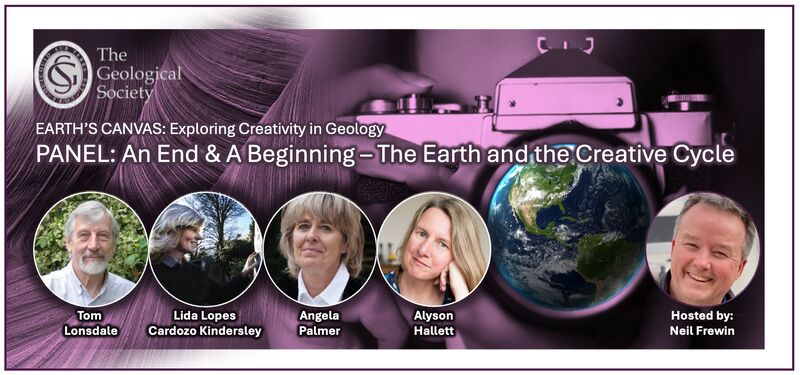
The Earth and the Creative Cycle: panel discussion at Earth’s Canvas (2024) 

How do artists bring together science, partnerships and materials for major projects? This was explored during a panel dialogue on 18 September 2024 as part of Earth’s Canvas. Facilitator Neil Frewin asked key questions of panelists Angela Palmer,  Tom Lonsdale,  Lida Lopes Cardozo Kindersley and Alyson Hallett.

How are logistics managed to deliver big projects? Angela described challenges such as dealing with power lines in Africa or Christmas lights in Trafalgar Square.

How can one choose a sense of place?  Tom said that you either feel the sense - or you don’t. You might have evidence of its history from physical clues, anecdotes or myth.

In art and creativity are you used to dealing with deadlines? Audience laughter met an assertion that artistic projects were not driven by deadlines. Nevertheless, Lida said that deadliness are not usually as pressing for headstones and memorials.

How scientists and artists build partnerships? Alyson views rocks as part of the team to be met, held, smelt, drawn and introduced.  Tom encouraged building skills of navigation, although partner organisation staff can rotate so relationships collapse. Lida starts with openness to possibilities - it’s not just ‘you telling me and me telling you’. Angela can’t do any work without partnerships and finds scientists can be incredibly generous.  Attendee Ruth Siddall noted that science councils do not value artistic collaboration given how science is assessed, but that arts and humanities organisations have proven much more receptive to funding cross-disciplinary work.

How can we measure the ‘impact’ of creative work when applying to funding bodies? Tom shared that conservation planning has useful words - harm and benefit - where the benefit should outweigh any harm. Alyson in an early project calculated the number of raindrops, leaves, cows interacting with a migrating stone - a playful approach that was funded. Angela sees outreach as an important measure such as with education departments in museums engaging children.  Lida had not heard the term ‘impact’ before today in the context of funding; she believes creativity is not about impact - we just want to make the world a bit better. These comments prompted contributions from a broader range of attendees. Olivia Rafferty saw the impact on development of the artist to enable them to go further down their road, create new work and reach out more. John Bolland reflected that impact can be greatest when the uncertainty on answering the question is greater. It can sometimes be enough to change just one person’s life. But if one can’t measure impact, what alternative method is there to assess a funding proposal? Measurement of ‘impact’ of a creative project for funding bodies was clearly the most contentious topic of the conference.

How can you sum up the experience of the last couple of days at Earth’s Canvas? Alyson thanked the generosity of the Geological Society and appreciated an amazing atmosphere of enquiry and sharing with ‘delicious’ conversation.  Tom was at a school that allowed the mixing of arts and sciences, and the conference was a glorious reassurance that these worlds are enmeshed. Lida said that we are all diggers, trying to do the hard work to get to some level of knowledge, meeting other diggers on the way.  Angela encouraged us to never stop being curious - highlighting the ‘impact’ of curiosity.

Earth's Canvas
https://geoscientist.online/sections/unearthed/earths-canvas-2/
Tom Lonsdale
http://www.placecraft.co.uk
Lida Lopes Cardozo Kindersley
https://en.wikipedia.org/wiki/Lida_Lopes_Cardozo_Kindersley
Angela Palmer
https://www.angelaspalmer.com
Alyson Hallett
https://alysonhallett.com
Neil Frewin
https://www.linkedin.com/in/neilfrewin
Ruth Siddall
https://ruthsiddall.co.uk/Home.html
John Bolland
https://aviewfromthelonggrass.com
Olivia Rafferty
http://www.oliviarafferty.com


Stone, creativity and community - the Isle of Purbeck 

A recent visit to the Isle of Purbeck showed how geology, stone and creativity can be deeply embedded in the life of a community.

The Etches Collection in the village of Kimmeridge displays a spectacular collection of fossil life from the Jurassic Kimmeridge Clay. I looked at the museum with an appreciation of creative materials and design. The overall impact is a venue of high quality, deserving of the public attention stimulated by the BBC documentary ‘Attenborough and the Giant Sea Monster’. The building is beautifully constructed with an appropriate use of local Purbeck stone.  The 'title' work outside shows insightful creative choices, with lighter stone for sky and darker stone for water. The ’cut’ lettering in lighter stone contrasts nicely with the 'relief' lettering in darker stone, and the living creature above the waterline contrasts nicely with its skeleton below the waterline. Inside, the hand-written letters on the museum labels are more vibrant and engaging to the reader than monotonous computer fonts or machine lettering. 

A walk along the Quarry-to-Castle trail revealed a profusion of active quarries on a variety of scales. The trail was created by Professor Patrick Corbett as a homage to his homeland and  loops through exposures of interesting shallow-water strata. Quarrying in Purbeck has evolved from hazardous manual underground mining to open cast methods with heavy machinery. The stone yards and limestone dry stone walls scattered across the landscape are almost works of art in themselves, evocative of the constructions of Andy Goldsworthy or Julie Brook. This has inspired the work of dry stone waller Jon ‘Baz’ Foot including a dry stone giant egg found outside the iconic Square and Compass pub in Worth Matravers. The pub has a room devoted to an amazing fossil collection of owner Charlie Newman; this was started by his father Raymond as recognised by letters cut in a plaque of the local shelly ‘grub’ stone by local stonemason Val Quinn.

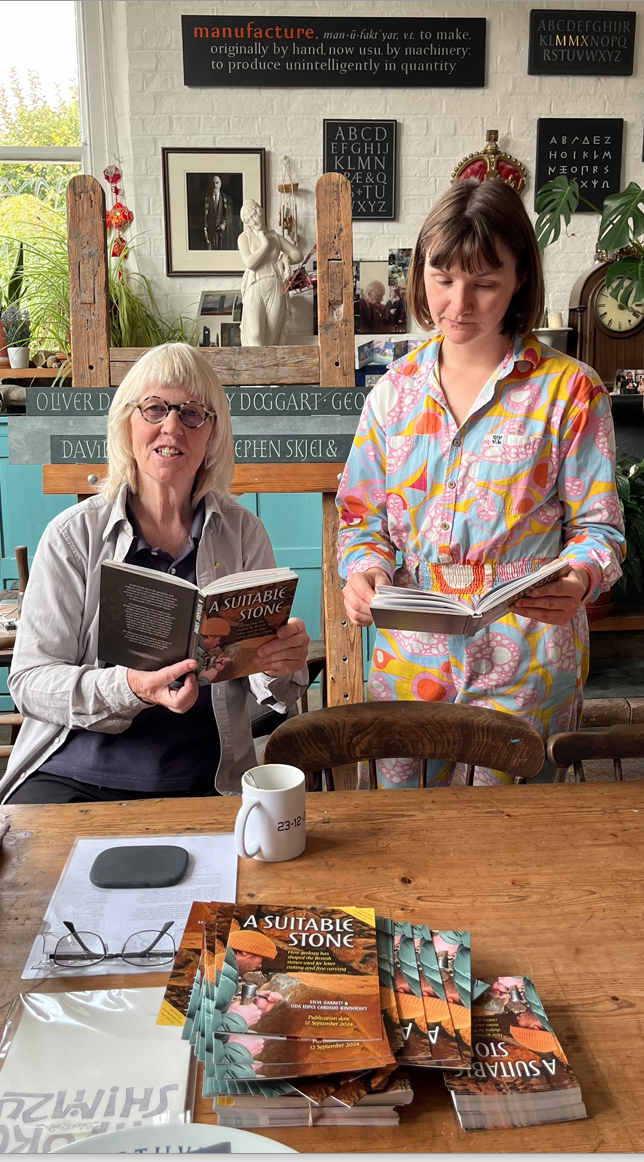
The Burngate Stone Centre in nearby Langton Matravers has been developed on the former site of decommissioned underground stone mining. The centre is set up for teaching stone carving to people of all ages and abilities, with courses focusing on creative carving and sculpture, the traditional skills of masonry and the discipline of lettercutting. There are many skilled tutors, some of who led a stone carving workshop as part of the ‘Earth’s Canvas’ event in 2024.  I gave a talk at the centre on the book  ‘A Suitable Stone’ , which included a recognition of the Purbeck beds as the youngest (Early Cretaceous) of the British stones regularly used for letter cutting and fine carving. These rocks, often shelly, were deposited in lagoons in fresh or brackish water, and can be used for letter cutting and fine carving, but  the underlying older marine Portland Stone has a finer grained consistent texture and is generally more amenable. Howard Gladden was an enthusiastic volunteer host and knowledgeable participant in dialogue. Anna Bowen, the local artist in residence at the centre, sent a list of stones she has worked with.

It was exciting to be in living, breathing museums and centres hosting work in the heart of  a historical stone production area. As a wise friend remarked, geology is in the blood of these Dorset communities, even if not all may be fully conscious of it. 


The Etches Collection 


’Cut’ lettering in lighter stone, 'relief' lettering in darker stone


Imbricate limestone dry stone walling


Stone yard piles


Plaque at the Square and Compass


Tools at the Burngate Stone Centre


Introducing the Purbeck as the youngest of British suitable stones


Etches Collection
https://www.theetchescollection.org/
Quarry to Castle trail
https://burngatestonecentre.co.uk/q2c-trail/
Square and Compass
https://www.squareandcompasspub.co.uk/
Burngate Stone Centre
https://burngatestonecentre.co.uk/
Burngate Tutors
https://burngatestonecentre.co.uk/tutors/
Anna Bowen
https://burngatestonecentre.co.uk/tuition/anna-bowen/


The power of illustration: Fiona Boyd and ‘A Suitable Stone’ (2024) 

Marking a year since the publication of ‘A Suitable Stone' gives an opportunity to celebrate the work of illustrator Fiona Boyd who is part of the Cardoso Kindersley workshop. I provided geological diagrams created on the computer which Fiona turned into illustrations by hand drafting, lettering and colouring.

It is striking how hand-drawn illustrations make the geology sing. For example, Lucy Williams’ review in Geoscientist says: ‘This book is exquisitely illustrated; the simple yet informative illustrations by Fiona Boyd are refreshing and bring to life maps, cross sections, and charts that will be familiar to geological readers, but here entice you to examine with fresh eyes.’

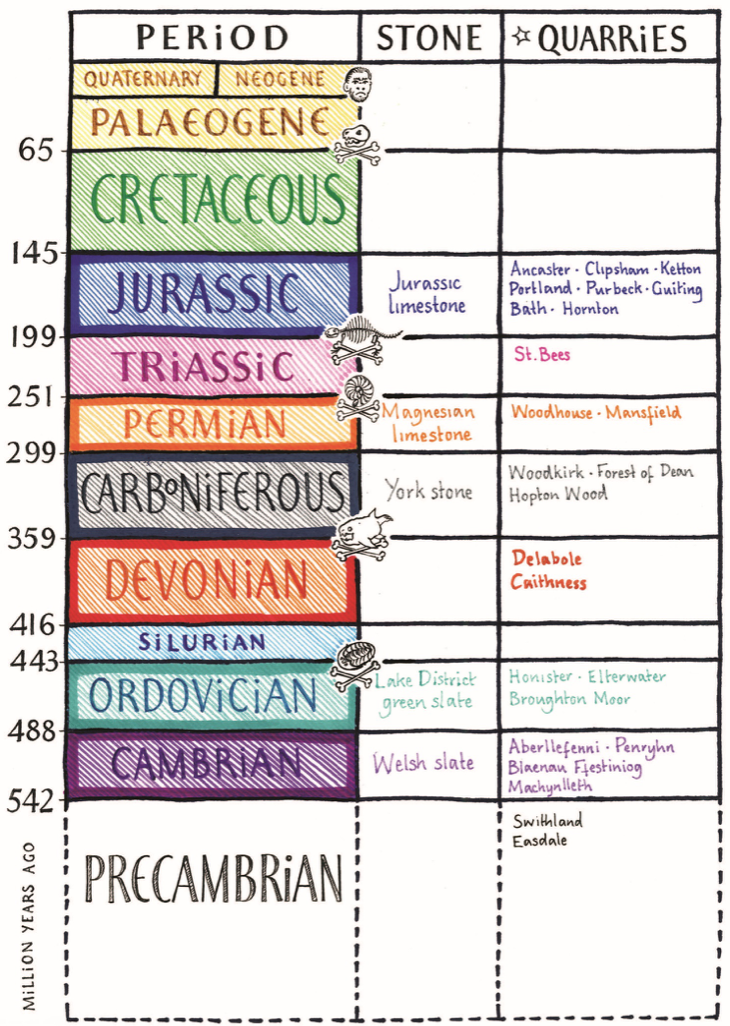
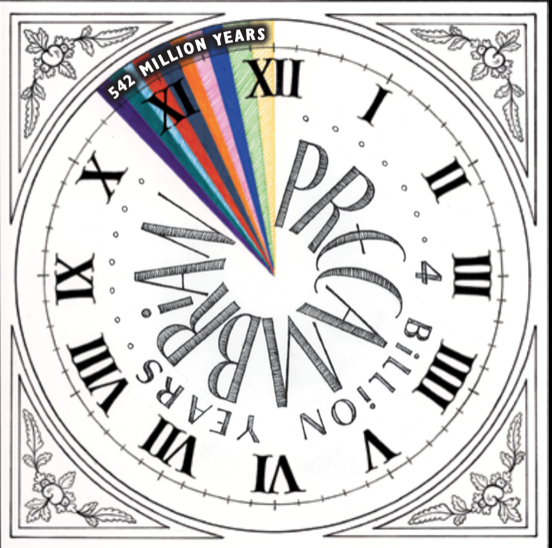
A tabulated geological time scale illustrates British ‘suitable stones’ used for letter cutting and their main source quarries. Small cartoons show creatures as the victims of mass extinctions - or in the case of humans, as the cause. This provides an opportunity for dialogue about different perceptions of time scales - for the letter cutter hundreds or thousands of years, for the geologist millions or billions of years. The workshop clock face with the Earth’s history shown as twelve hours highlights the extent of the Precambrian before the suitable stones were formed.

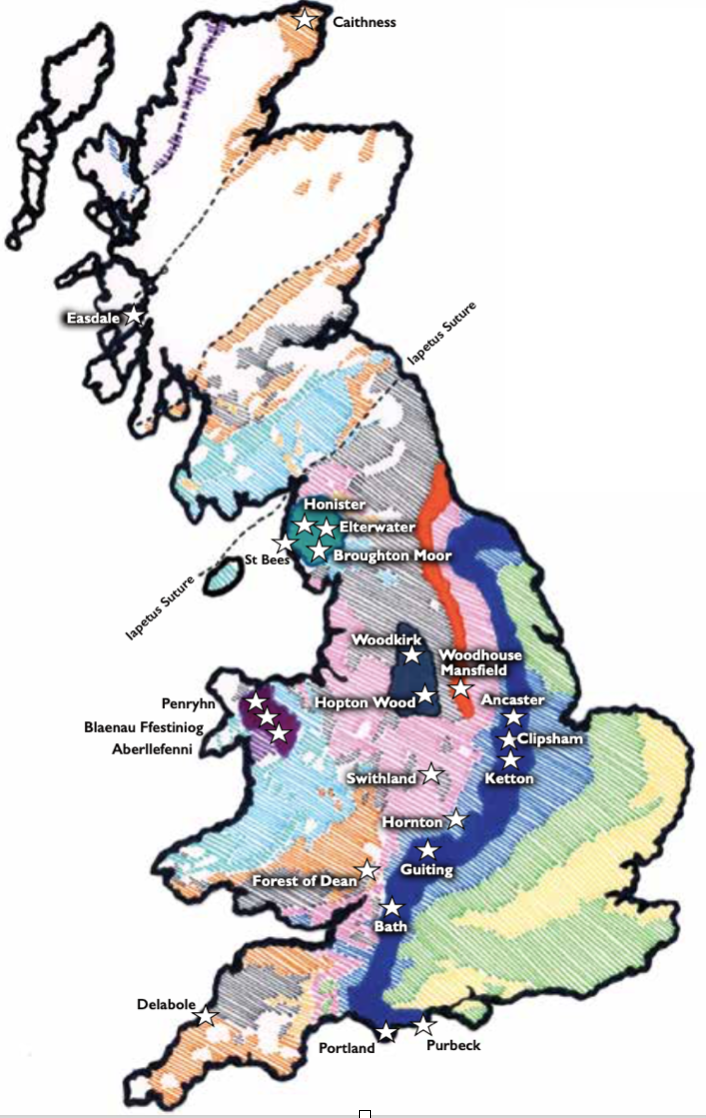
A geological map of Britain with outlines for the sedimentary, volcanic and slatey strata was built using the BGS tool ‘Make a Map’. The main ‘suitable stones’ are in bold colour with the other stones shaded in and quarries  are highlighted as stars. A prominent band of blue Jurassic limestone (e.g. Portland stone) crosses England. The main Scottish geological structures are shown with igneous and metamorphic rocks but few ‘suitable stones’ north of the border.

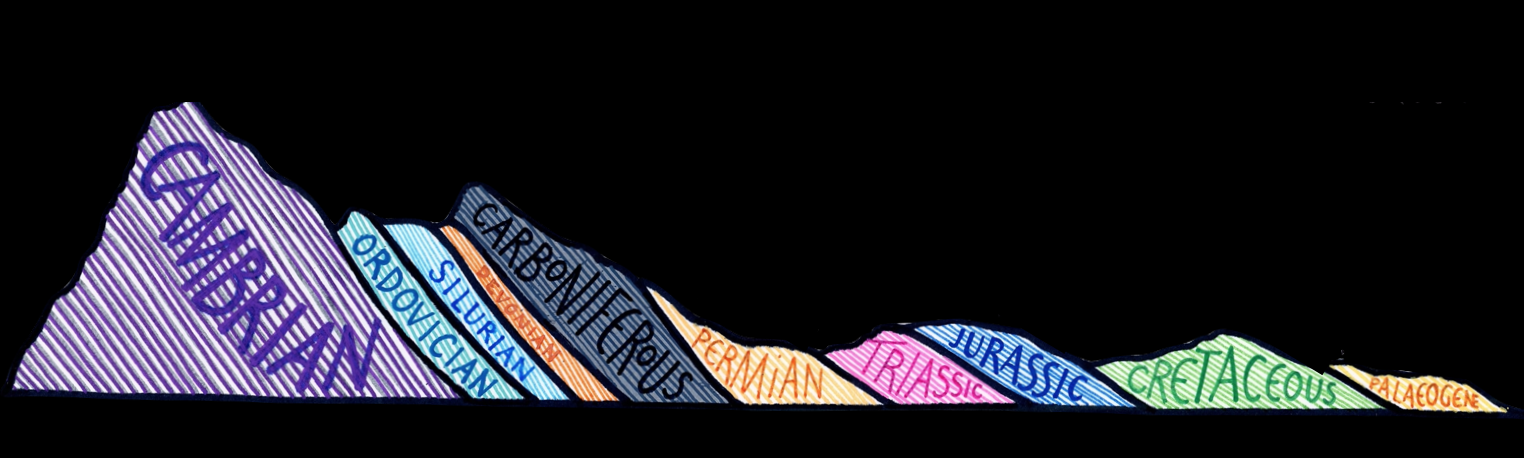
A cross-section mirrors the one accompanying William Smith’s map, both as a homage to Smith as a great illustrator, and to show how in England and Wales the rocks generally become younger on a traverse from northwest to southeast.

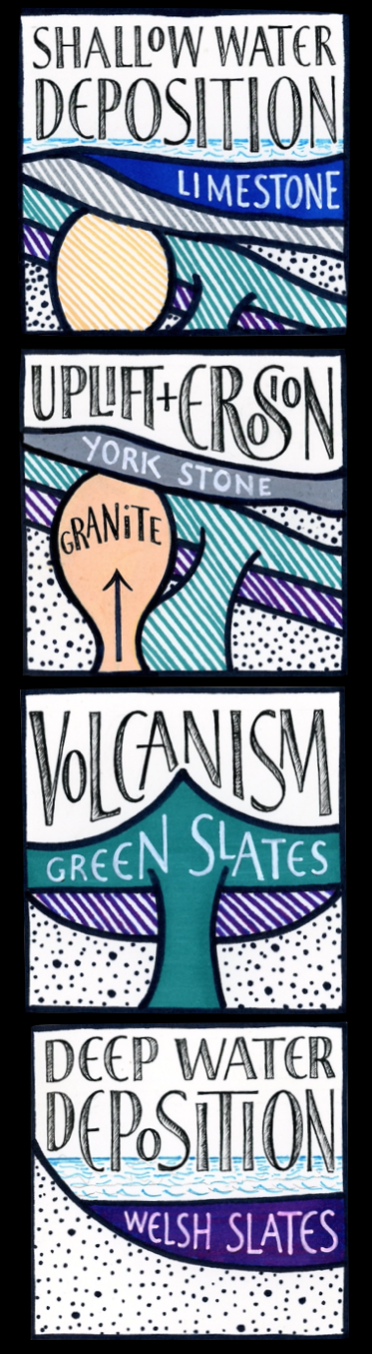
Cartoons illustrate the geological processes contributing to the formation of the stones. These attempt to show a geological cycle. Deep water deposition is followed by  volcanism during closure of oceans. Uplift and erosion of sandstones follows continental collision. Sea level rises the land subsides as limestones are deposited in tropical conditions.

For those interested in further delving into geological illustration, a history of drawings stretching back to Leonardo da Vinci is given on YouTube  by Earth scientist and illustrator Vojta Hýbl. Another current geological illustrator is Lucía Pérez-Díaz whose work invites us to consider ‘How the Earth Works’ or to travel to time periods such as the Cambrian to ‘Explore an alien world without leaving Earth’.

From my own experience, I have seen how Fiona’s work is a powerful example of how illustration and lettering can bring our stories of the Earth to life.

Lida Lopez Cardoso Kindersley and Fiona Boyd

A geological time scale

The age of the Earth on a twelve hour clockface


A geological map of Britain with ‘suitable stones’

A cross-section across Wales and England


Cartoons of geological processes creating the ‘suitable stones’


A Suitable Stone: How geology has shaped the British stones used for letter cutting and fine carving
https://stevegarrettguitar.com/a-suitable-stone
https://www.kindersleyworkshop.co.uk/shop/p/a-suitable-stone-pre-publication
A Suitable Stone: Geoscientist review
https://geoscientist.online/sections/books-and-arts/a-suitable-stone/
Fiona Boyd
https://www.instagram.com/feeownahboyd
British Geological Survey map maker
https://www2.bgs.ac.uk/discoveringGeology/geologyOfBritain/makeamap/map.html
Putting Rocks on Paper: The Art of Geological Illustration
Vojta Hýbl
https://vojtahybl.com/
Draw them in: the art of geoscience communication through illustration
https://geoscientist.online/sections/unearthed/draw-them-in/
Lucía Pérez-Díaz
https://www.luciaperezdiaz.com/

Using creative work to educate and engage - Knockan Crag (2001) 

Creative works can be inspired by geology. But it is also inspiring to see how creative works can help to educate and engage at an iconic locality.

We were fortunate to be part of a walk around Knockan Crag by Jan Breckenridge, currently the Education and Engagement Officer with the NW Highlands Geopark. Jan was a key person in the redesign of the site launched in 2001 which included the commission of new art. 

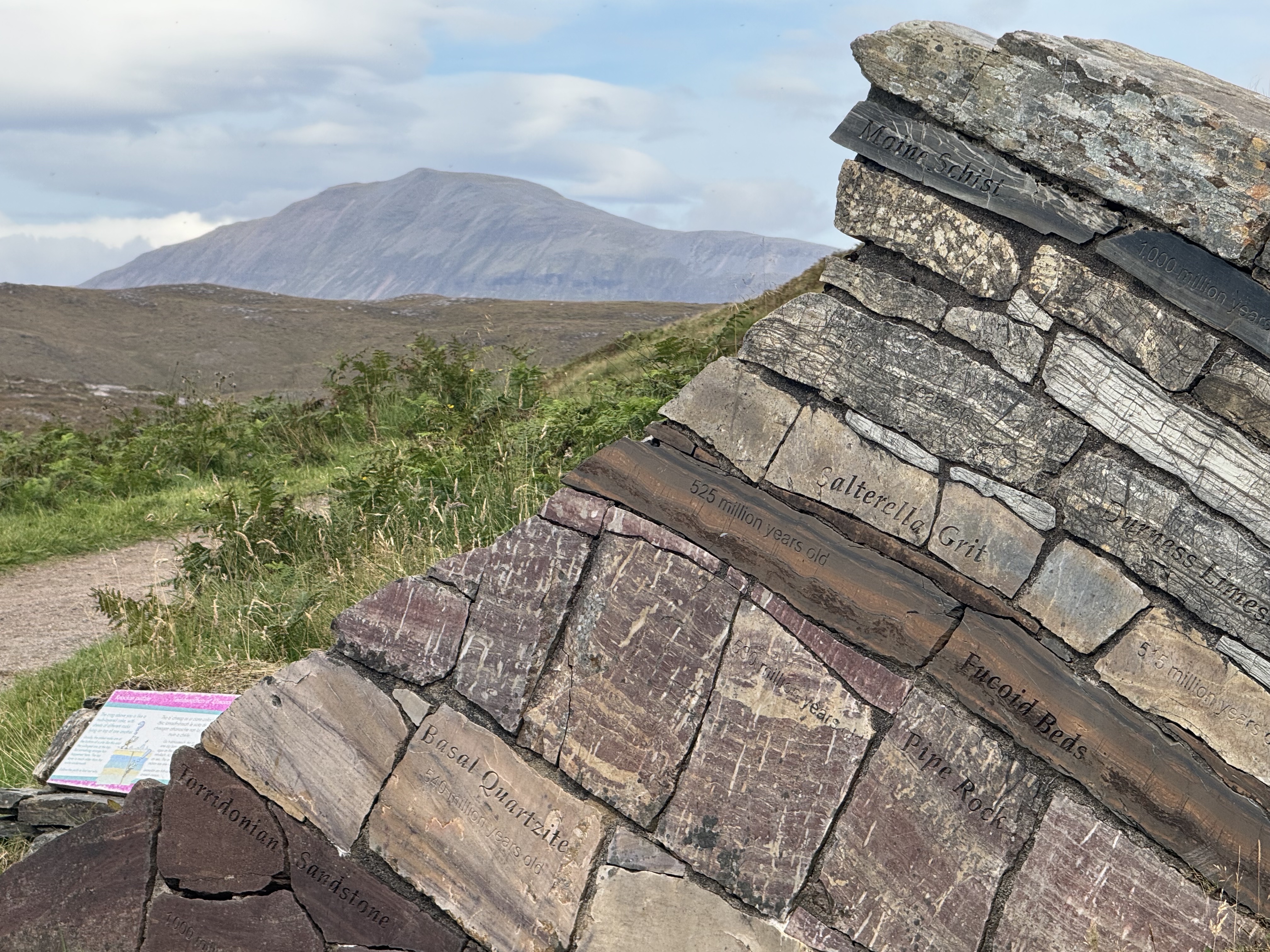
A memorial wall by Don Shelley has stacked samples of the geological layers seen in the region - a labour of love which pre-dated the site redevelopment. The layers dip to  the east mimicking he dip slope on the east flanks of surrounding hills. The fundamental problem is evident - how did the older metamorphic rocks come to lie on top of the younger sedimentary rocks?

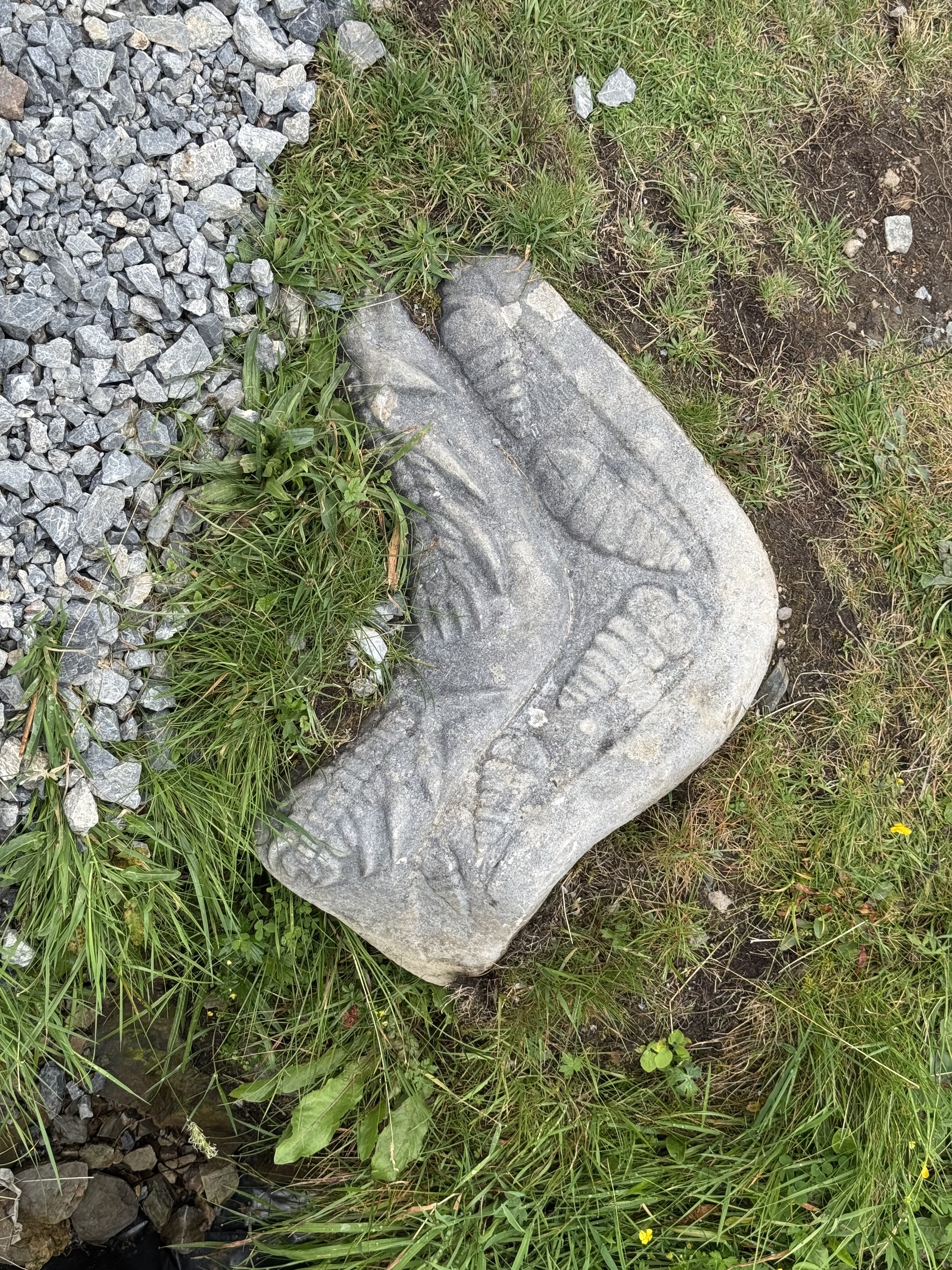
The walk up to the crag is marked in 100 million year steps.  Sculptures by Susheila Jamieson to highlight the fossils such as Pipeworm and trilobites, leading us to image the teeming life in the Cambrian seas as life exploded.

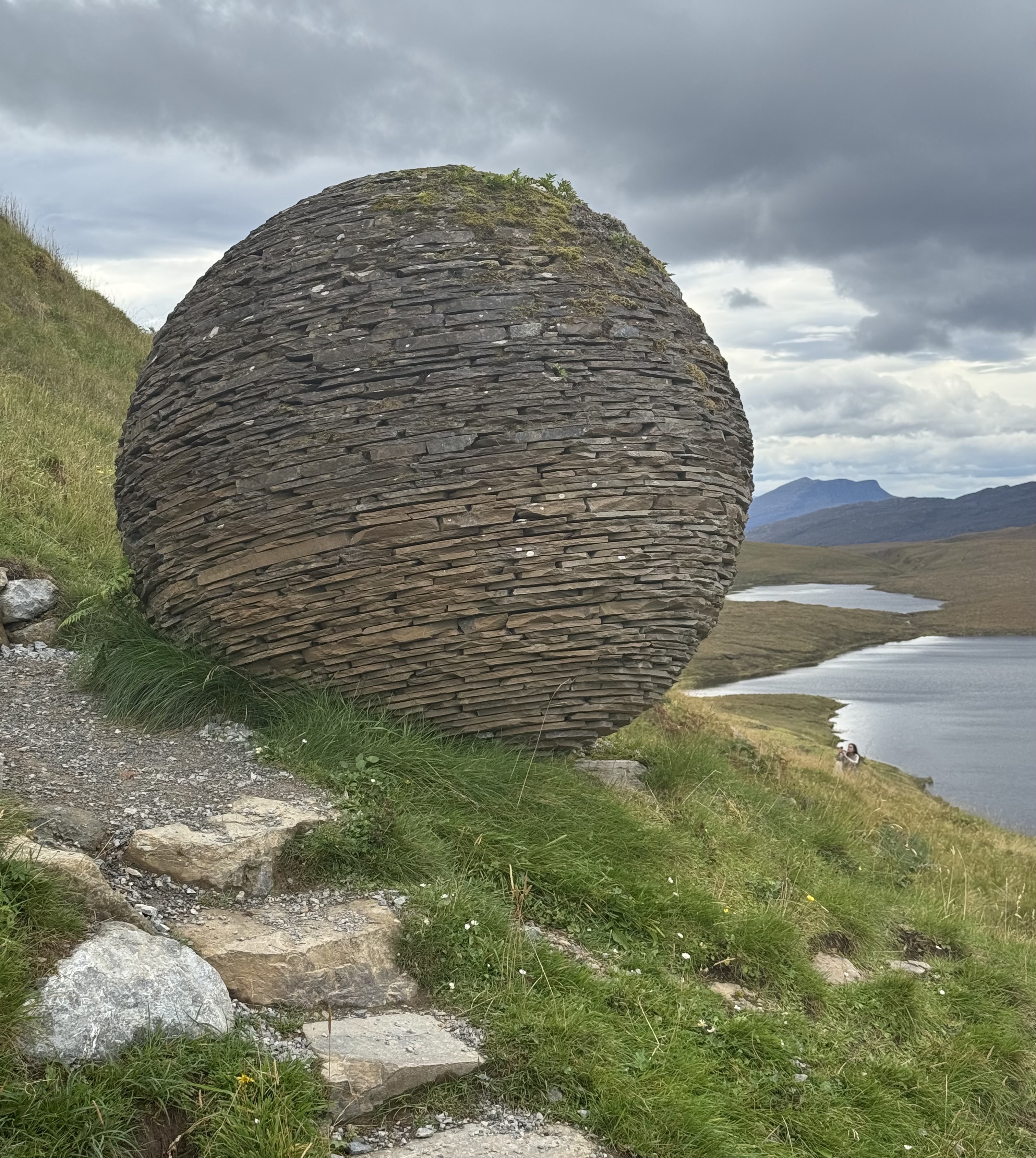
Tilted Globe by Joe Smith is a sphere made from layers of drystone. The layers are not horizontal giving the globe an apparent tilt mirroring the tilt of the Earth. Jan explained that Joe had trained Andy Goldsworthy as they worked together from 1989 to 1993. The work reminds us of the global impact of the revelations at Knockan Crag.

Stones set in the ground have inscribed poetry by Norman McCaig including these resonant lines from A Man in Assynt

Who possesses this landscape? 
The man who brought it or 
I who am possessed by it?

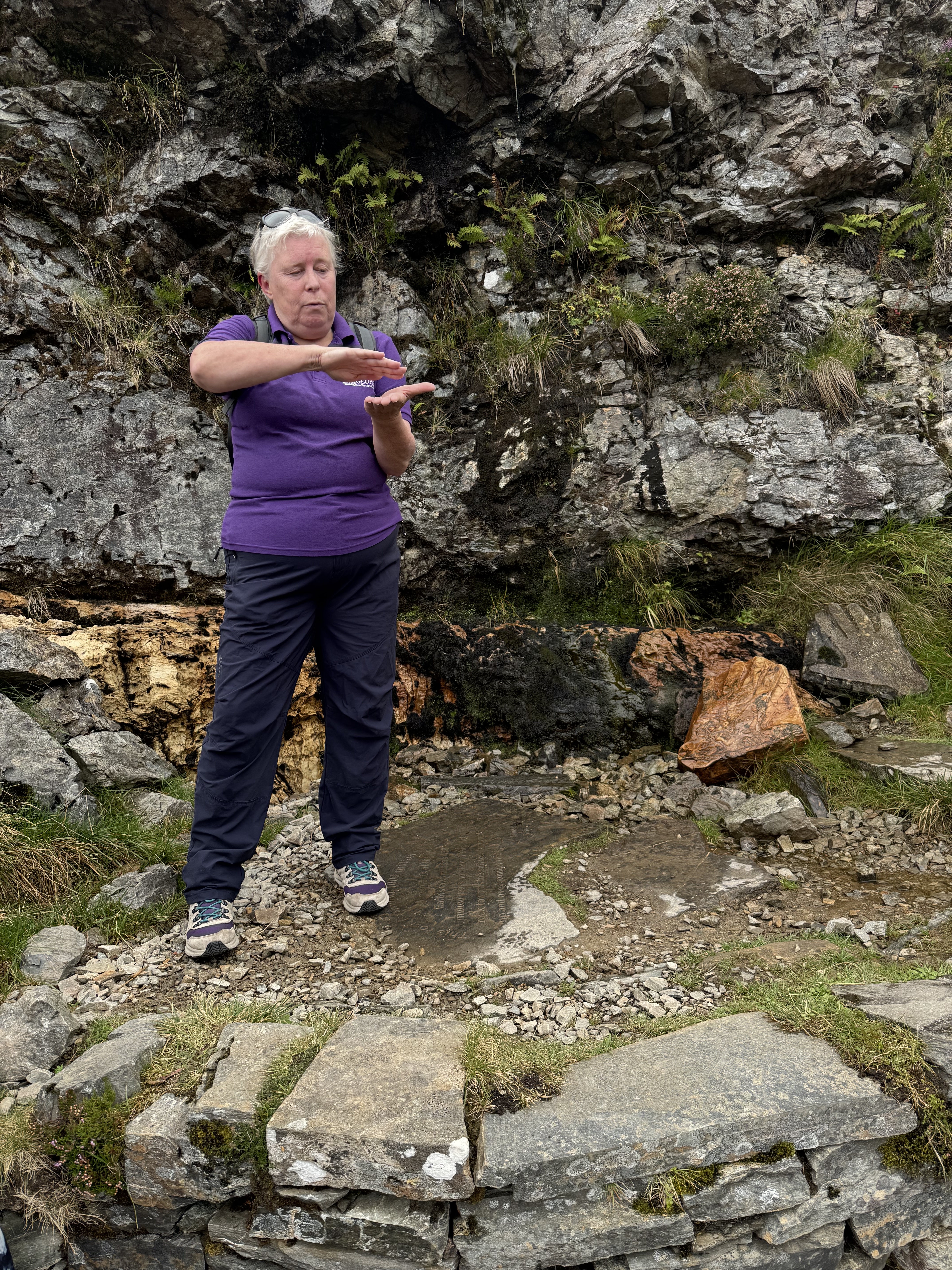
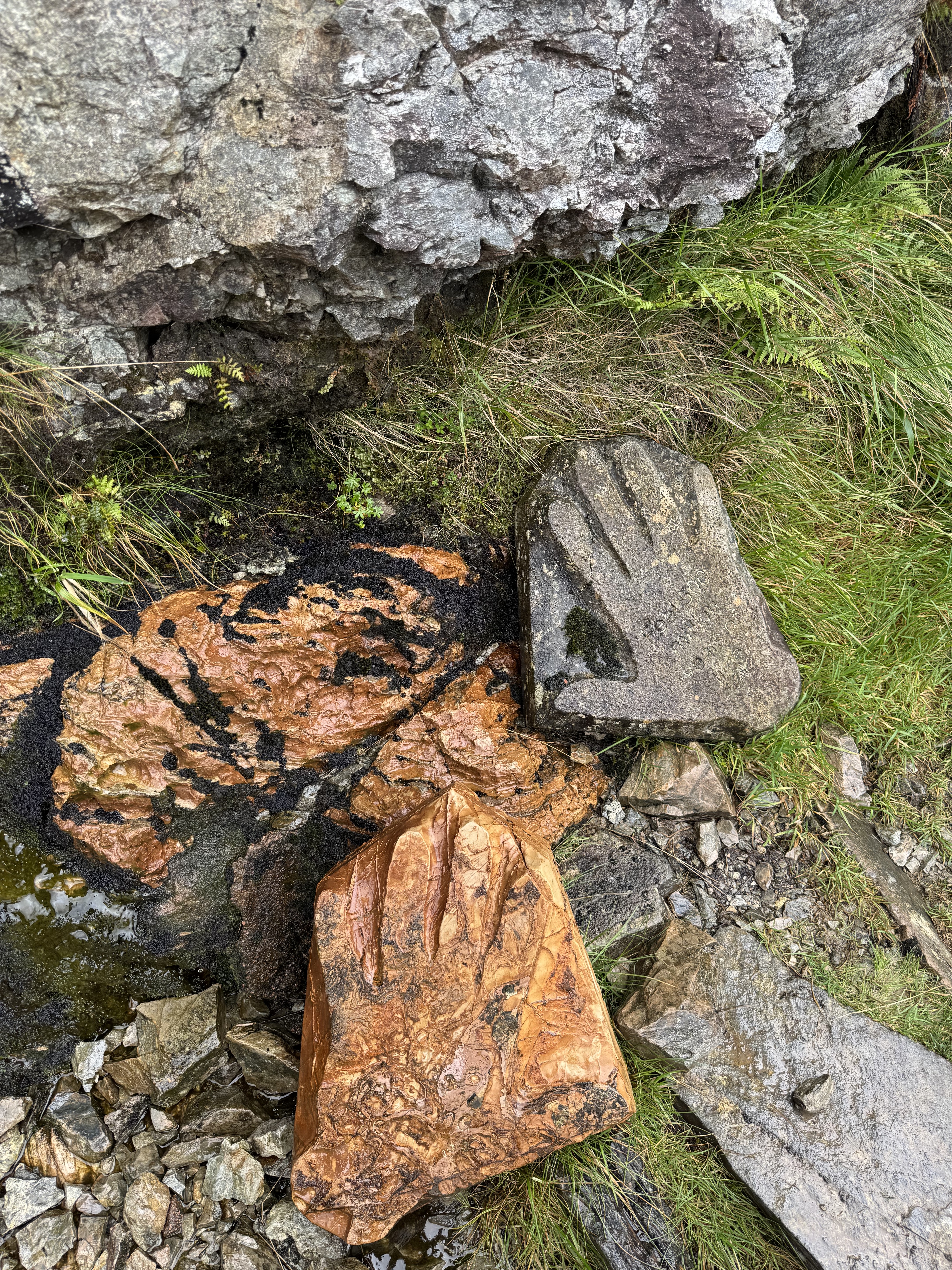
Jan then took us to the thrust plane and used her hands to demonstrate the movement of rocks. The hand sculptures set into the ground encourage us to touch the thrust plane between the orange limestone below and dark metamorphic rocks above. It is easy to see how those involved in the ‘Highland controversy’ in the 1800s struggled to understand these relationships as the contact between the two layers otherwise looks so ‘normal’.

Climbing up the path, a stone bench is flanked by Hutton’s quote ‘Go to the mountains to read the immeasurable course of time’. The bench provides a welcome respite for those not built for hill walking and an opportunity to contemplate.

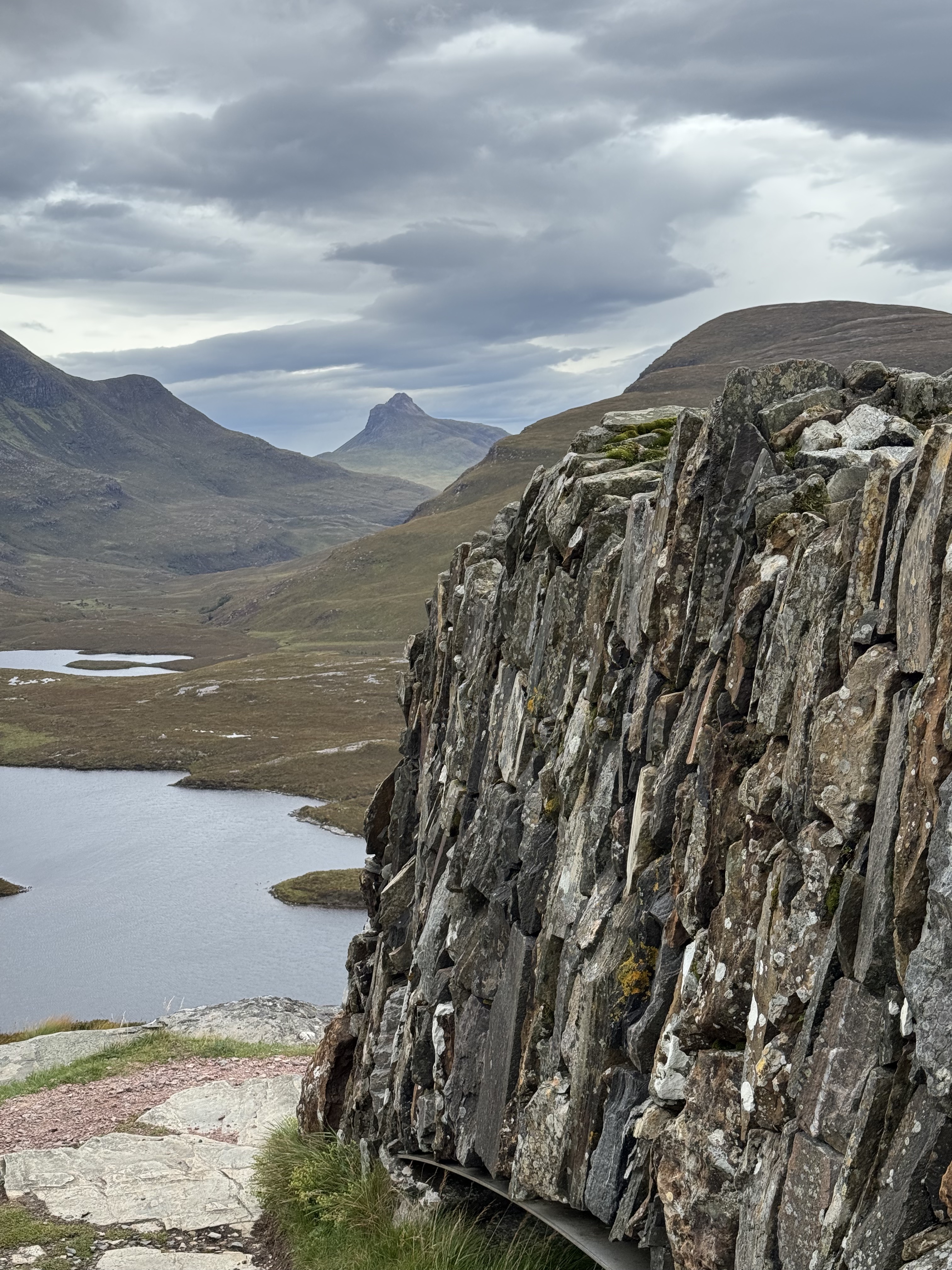
The reward for climbing to  the top of the hill is ‘Thrust’ imagined by Frances Pelly realised by Joe Smith with Max Nowell. The is a drystone wall partially supported above the ground on a curved metal beam. The near-vertical orientation of stones not geologically correct as the rocks here dip more gently. Nevertheless the work is a good focus for reflection on Earth processes and the broader structure of the thrust and rocks across the region.

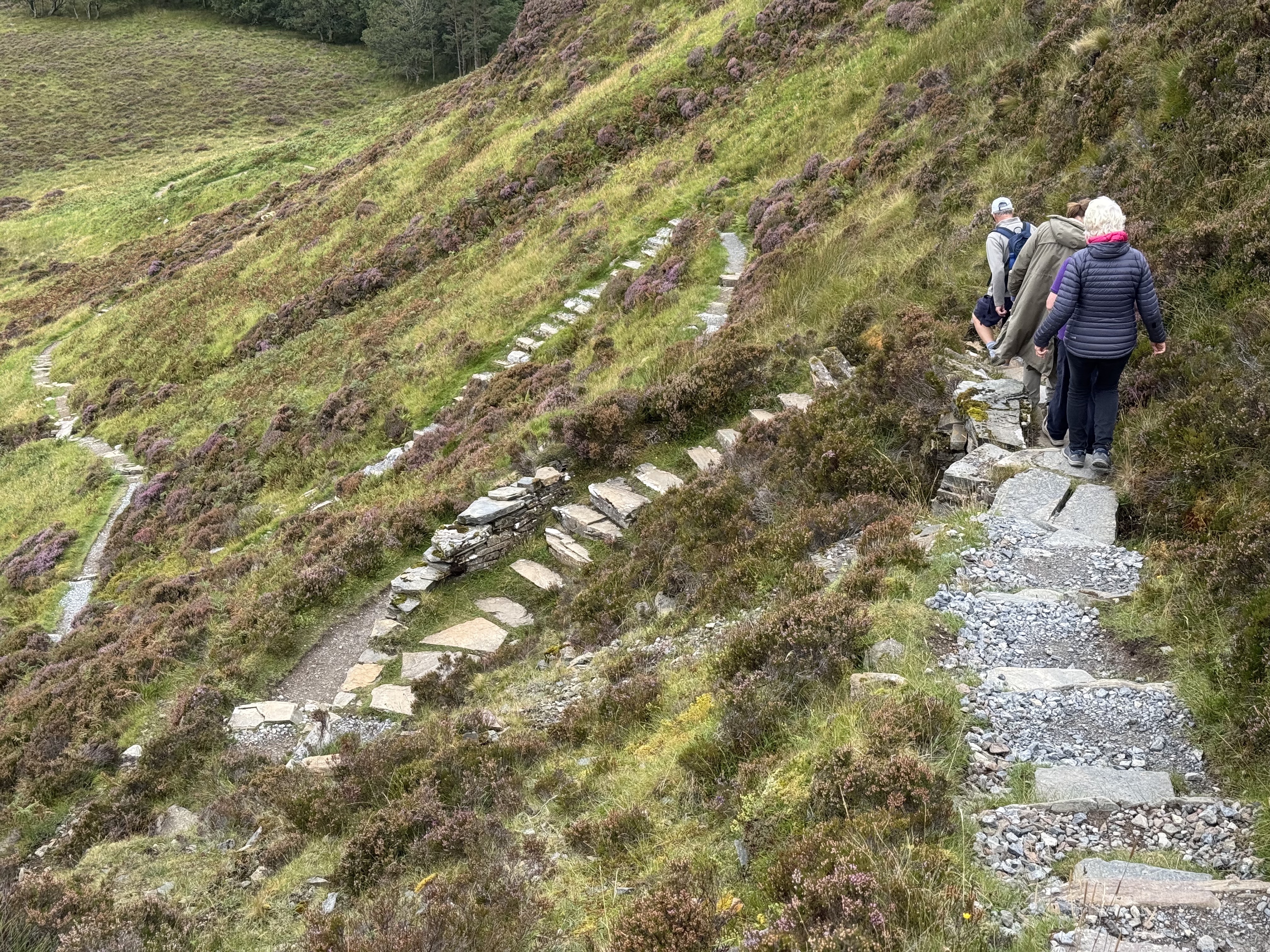
The steep steps on the way down are perhaps in a way their own work of art work of art, echoing  the work of Julie Brook such as Surrag Path feautured in my last blog.

Jan's excellent tour not only illuminated the geology but showed how the planned use of art in site design can aid in education and engagement regarding key Earth processes.
 

Memorial wall by Don Shelley

Trilobites by Susheila Jamieson

Tilted Globe by Joe Smith

Jan Breckenridge demonstrating motion on the Moine Thrust

Hands on the Moine Thrust

‘Thrust’ imagined by Frances Pelly realised by Joe Smith with Max Nowell

Steps on the way down from Knockan Crag
NW Highland Geopark
https://nwhgeopark.com/our-story/who-we-are/
The Highland Controversy
https://nwhgeopark.com/landscape/the-highlands-controversy-early-progress-1/
Donald Robert Shelley (1933-2002)
https://edinburghgeolsoc.org/home/obituaries/#shelley
Jan Breckenridge and others. 2015. The Story of Knockan Crag National Nature Reserve. Scottish Natural Heritage. 2nd Edition.
https://web.archive.org/web/20210525074711/https://www.nature.scot/sites/default/files/2018-02/The%20Story%20of%20Knockan%20Crag%20National%20Nature%20Reserve.pdf
Pipe Worm bySusheila Jamieson
https://artuk.org/discover/artworks/pipe-worm-286626
Tilted Globe by Joe Smith
https://artuk.org/discover/artworks/tilted-globe-286627
Thrust by Frances Pelly and Joe Smith with Max Nowell
https://artuk.org/discover/artworks/thrust-286628

Art emerging from an ancient landscape - ‘Surrag Path’ (2023) by Julie Brook 

I, with geological companions Kitty and Lucy, have just returned from the remote Aird Mhor and Aird Bheag peninsulas on the border between Harris and Lewis to experience the art of Julie Brook. These areas are only accessible by boat and are often accessed by walks on steep pathless land. With no other people encountered, it was possible to experience a very direct response to the landscape, rocks and art.

The boat pickup point at Hushinish slipway is on Lewisian metamorphic rock (‘gneiss’) which has an age of 3.1 billion years - the oldest known rocks known in Britain and Western Europe.  Waiting for the boat, we could appreciate these rocks knowing that they have endured for most of the lifetime of the Earth (4.5 billion years). 

We climbed to the crest of hills made of granite sheets and intrusions formed during Laxfordian times 1.9 billion years ago.  We speculated that the white hard rock core of summits stretching north along the Uig Hills might be anorthosite - a  similar resistant rock forms the highlands on the Moon.

Glaciers  in the past 2 million years provided the final polish to the landscape and created distinctive north-south  U-shaped valleys and steep slopes. Some of these late erosional features may have been focused along structures formed more than a billion years beforehand.

Julie said “When I came here this felt like an old landscape. Now I know why it is”.

We explored the relationship between geology and Julie’s recently completed work ‘Surrag Path’, a staircase along the side of a sharp-sided valley.  When viewed from the sea on our approach, the valley looked like a fault or fracture zone which had then focused water flowing as the glaciers melted, bringing boulders and coarse rocks to wedge in the gulley. Selecting the stones for this staircase had required Julie and her team to scour the surrounding land for stones that would fit together. We saw boulders and stones perched by nature on the crests of hills and along ridges, suggesting that material had lain in position for thousands of years since the glaciers retreated.

We also looked at the ‘Winter Wall’, viewed the site of ‘Firestacks’ from above, and a new work in progress on the flanks of Meall nan Sithean.

We benefitted from the warmest of welcomes from Julie and her strong, dynamic, experienced and capable leadership; deepening connection borne of time together; walking on ancient hills; exhilarating travel by boat; fighting the midges; nurturing and rescuing dogs; music and singing in the evenings; and animated conversations over home-cooked food.

Julie as an artist responds to the shape of landscape, to the sense of isolation,  with the choice of materials, and through the hard labour of construction. Earth scientists look for patterns in nature and delight in storytelling of the origin of our planet. We are connected by our human response in awe of an exceptional remote natural environment.

Lewisian gneiss at Hushinish - the oldest rocks in Britain
 

Ascending Laxfordian anorthosite(?) hills

Looking north at the edge of a glacial valley formed along an older fault line
 

Looking east along the gulley which hosts ‘Surrag Path’

The intrepid Milly on ‘Surrag Path’

An ancient landscape, North Harris, Outer Hebrides

Julie Brook
https://juliebrook.com
Brook, J., Groom S., Harris, A., Jikinyum R and Macfarlane, R.2023. What is it that will last? Land and tidal art of Julie Brook.
https://www.lundhumphries.com/products/what-is-it-that-will-last
Fettes, D J, Mendum, J R , Smith, D I and Watson, J V  1992 Geology of the Outer Hebrides: Memoir for 1:100 000 (solid edition) geological sheets, (Scotland). British Geological Survey. 
Friend, C and Kenny, P.  2001 A reappraisal of the Lewisian Gneiss Complex: geochronological evidence for its tectonic assembly from disparate terranes in the Proterozoic. Contributions to Mineralogy and Petrology 142, 198–218
Goodenough, K M and Finlayson, A. 2006. The geodiveristy of the Isle of Harris: statement of significance and identification of opportunities. British Geological Survey report CR/07/032N
https://nora.nerc.ac.uk/id/eprint/7490/1/CR07032N.pdf

Sampling deep time - Katie Paterson's 'Requiem', 'Endling' and '〇' (2022-2025) 

Artists and creators are often inspired by deep time but may not have done extensive geological research or engaged with the Earth science community. So it is pleasing to encounter the work of  Katie Paterson.

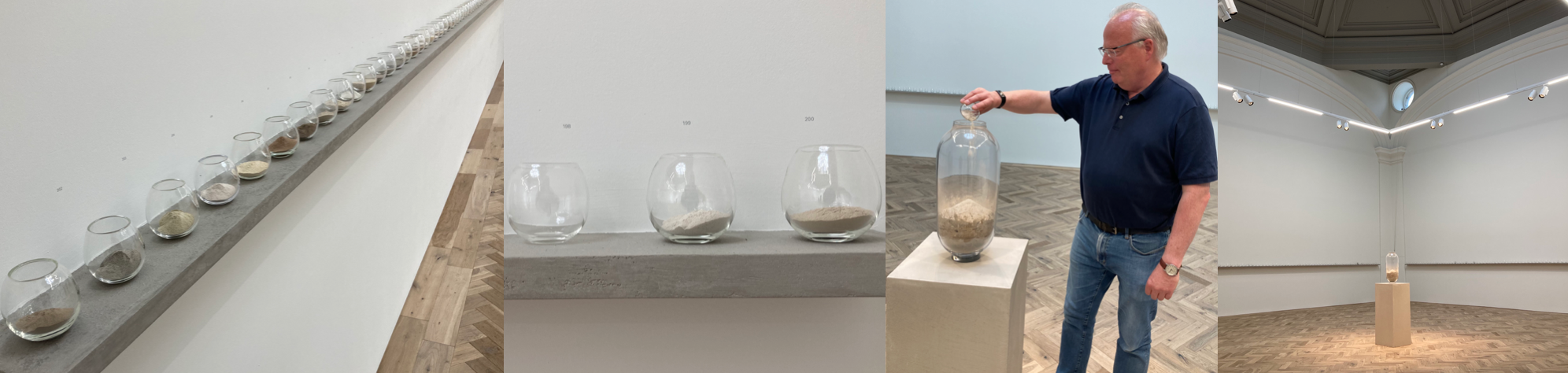
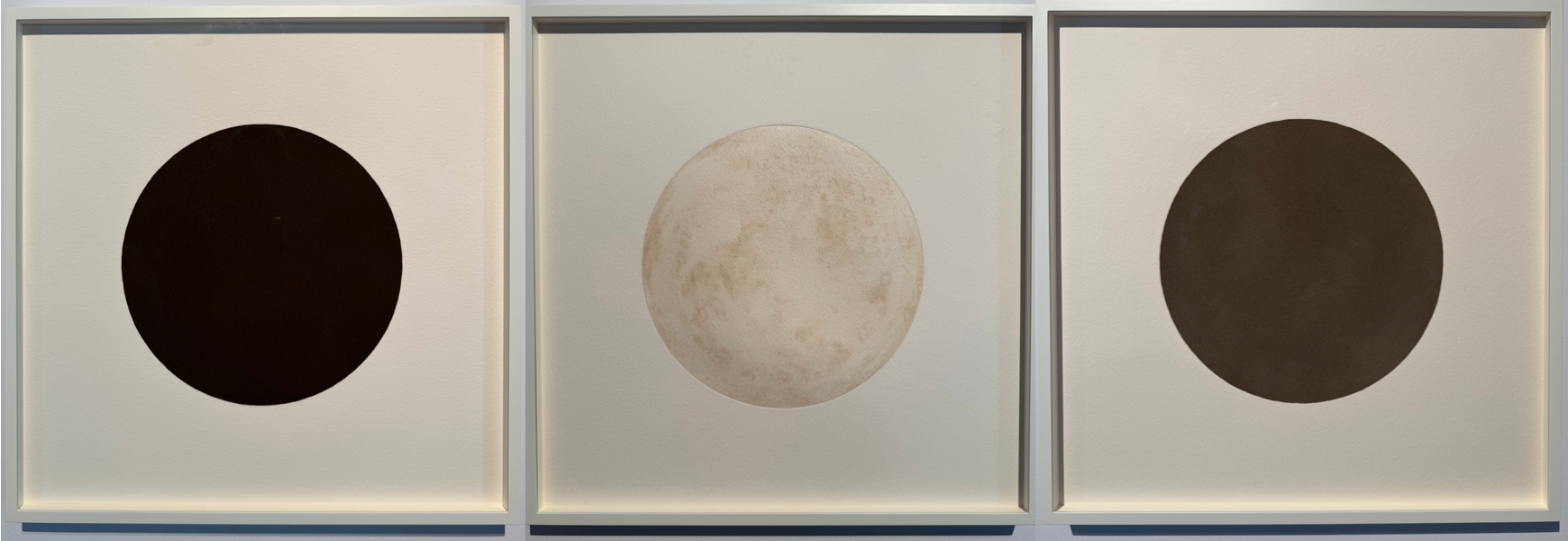
Ground rock provides the materials.  A first glance reveals colours like soil: mostly brown, black and grey, perhaps underwhelming and anonymous. But these are more than pigments. The provenance, labels and narrative text open the imagination to the formation of the Earth and the evolution - and extinction - of life.

Requiem (2022) tells of the birth and life of our planet in a single object hosting a layering of 364 samples from pre-solar times to today. I visited Ingleby Gallery, Edinburgh twice. First, a reconnaissance to take in the scope of the work. Second, a return a month later when I was honoured to pour sample 199 - a moving experience. This was from 30 million years ago (near the start of the Oligocene epoch) as the Earth cooled and polar caps formed while Antarctica was separated from other continents  A further 165 remaining samples taking us to the more vivid colours of the Anthropocene (be it epoch or event), stretched out along the shelves to be added in the days thereafter. The text from geologist Jan Zalasiewicz and photos in the accompanying book provide a wonderful record for those not able to directly experience the work. In a way it is sad to think of the empty sample glasses at the end of the project. The final product was fired in a kiln at the National Glass Centre giving  An urn built to house the ashes of future earth’.

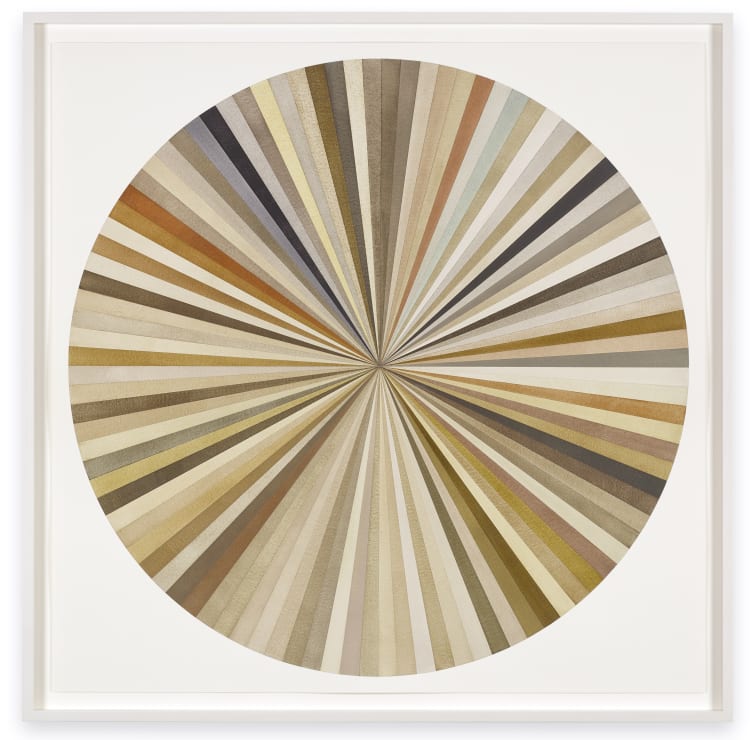
The exhibition also included Endling (2022), a one metre diameter circle divided into one hundred sections, each painted with samples from different times. The earliest Earth begins at ‘12 o’clock’ and the segments take us in one image through the history of the planet, with black streaks from coal deposits standing out as markers.

I saw ‘’ (2023-2025) in May 2025 at the Expanding Landscapes exhibition put on by Lakeland Arts at Abbot Hall, Kendal. It was wonderful for us to meet and chat with Katie at the opening event. Each circular painting has its own geological story and pigment, including salts left from dried-up oceans and a mixture of materials from the interior of the Earth. These offer offer ‘…a sensory experience of deep time’ ‘encapsulating the very forces that have shaped our world’.

These works impress not only with the vision of artistic creation, but also with the scale and scope of project management and collaboration required to realise them.

Katie’s work provides a focus for reflection on how small our human span has been in the life of our amazing planet - and how the Earth will, in the long term, survive and thrive (even if our species doesn’t).

Visiting ‘Requiem’  at Ingleby gallery, Edinburgh, 26 May 2022

Endling (2022)
 

  V VI IX (2022-2025)  at ‘Expanding Landscapes’, Abbot Hall, Kendall , Lakeland Arts, 16 May 2025

Katie Paterson
 https://katiepaterson.org/
Requiem (2022) 
https://katiepaterson.org/artwork/requiem/
Requiem (2022) Text by Jan Zalasiewicz
https://katiepaterson.org/wp-content/uploads/2022/03/Requiem_Newspaper.pdf
Endling (2022) 
https://katiepaterson.org/artwork/endling/
〇  (2022-2025)
 https://katiepaterson.org/artwork/o/